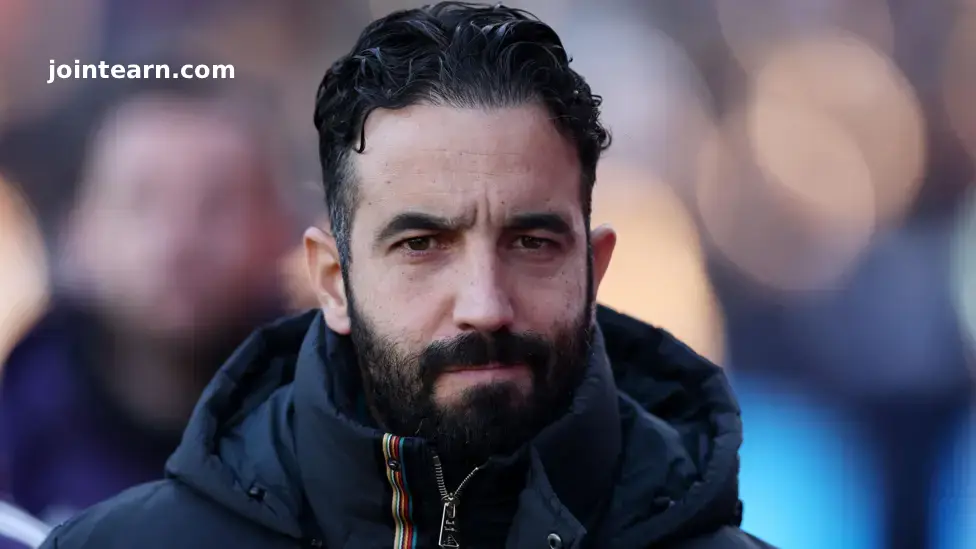
Manchester United manager Ruben Amorim has revealed that he deliberately avoids social media and television coverage to shield himself and his family from online abuse. The Portuguese manager, appointed in November 2024, spoke candidly about the pressures faced by football managers in the Premier League, highlighting a growing problem of online threats and harassment.
Social Media Abuse in Football
A recent BBC investigation, conducted in collaboration with data science firm Signify, found that during a single weekend last month, over 2,000 highly abusive messages were directed at managers and players in the Premier League and Women’s Super League. The abuse ranged from racist and homophobic slurs to death and sexual assault threats, with Amorim, Liverpool manager Arne Slot, and Newcastle United boss Eddie Howe being the most targeted in men’s football.
Amorim explained his approach to dealing with this issue:
“I don’t read it; I protect myself. I don’t watch TV when they are talking about Manchester United, not because I don’t agree—most of the time I do—but it’s a way of being healthy. My feeling as a coach is enough. The only way—there is no other way—is to protect myself.”
The analysis found that 82% of abusive posts appeared on X (formerly Twitter), with 61% originating from accounts in the UK and Ireland. The study also suggested that the overall volume of online abuse directed at football personnel is increasing.
Impact on Professional and Personal Life
Amorim admitted that avoiding social media has financial implications. He said,
“I lose money from sponsors. On Instagram, I could earn a lot of money, but for my protection and living a normal life, it’s not worth it.”
Despite the abuse, Amorim stressed his resilience:
“Nobody can be tougher than me when we lose and when we don’t play well. Nowadays, it’s really normal to have that abuse, so it’s the only way to survive in this world.”
Manchester United’s Current Form
United endured a disappointing 15th-place finish last season—their lowest since relegation in 1973-74. They were beaten by Tottenham in the Europa League final, missing out on European football.
This season has also been challenging. United were eliminated from the Carabao Cup by League Two side Grimsby Town and currently sit seventh in the Premier League, ahead of Thursday’s home game against West Ham.
Injury Updates and Player Development
Amorim provided positive news on striker Matheus Cunha, who is fit to return after a two-match absence due to a head injury. However, defender Harry Maguire and forward Benjamin Sesko remain sidelined, and Amorim expressed concerns over two unnamed players, which could affect squad selection.
Cunha, who took nine games to score his first goal for Manchester United after his £62.5m transfer from Wolves, has been criticized on social media. Amorim said,
“He has more levels to go. He is at a different club with different pressure, but I think he copes with that well. He was struggling because he was not scoring and thinking too much about the numbers. His influence in the team is important, and he still has room to grow defensively and offensively.”
Managing Pressure in Modern Football
Amorim’s approach underscores the mental resilience required in top-level football management. By avoiding toxic online commentary, he aims to maintain focus on team performance and player development rather than external distractions. His comments shed light on the increasing importance of mental health awareness for managers and players in elite football.
Key Takeaways
- Ruben Amorim avoids social media to protect himself and his family from abuse.
- Over 2,000 abusive posts targeted Premier League and WSL managers and players in a single weekend.
- Manchester United currently sits 7th in the Premier League, after a challenging previous season.
- Matheus Cunha returns from injury, with Amorim emphasizing his ongoing development.
- The story highlights the growing problem of online abuse in football and its impact on mental health.


Leave a Reply