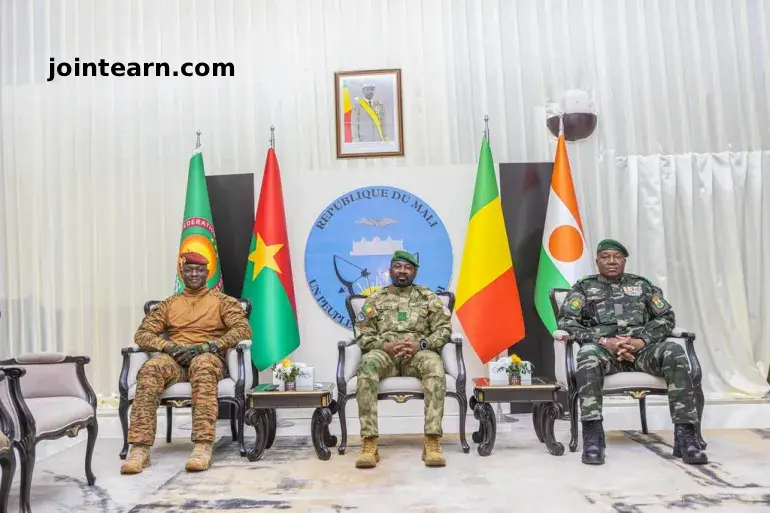
Mali, Burkina Faso, and Niger have announced the formation of a joint military battalion aimed at combating armed groups across the Sahel, one of Africa’s most vulnerable and conflict-prone regions. The announcement came at the conclusion of the two-day Alliance of Sahel States (AES) summit held in Bamako, Mali, as the three countries face escalating attacks from separatists and extremist groups linked to al-Qaeda and ISIL (ISIS).
This marks the second AES summit since the alliance’s creation in 2023, highlighting the countries’ intent to strengthen regional cooperation in security and development.
Key Decisions from the Summit
The AES leaders agreed to:
- Launch a joint battalion of approximately 5,000 soldiers, focusing on counterterrorism and border security operations.
- Conduct large-scale joint operations against armed groups in the coming weeks, announced by Burkina Faso’s President Ibrahim Traore, who was named head of the alliance.
- Launch AES Television, intended to counter misinformation and promote the region’s narrative.
A Burkinabe presidency statement emphasized that the leaders will continue reviewing implementation reports, consolidate achievements, and address the major security and developmental challenges facing the bloc.
General Omar Tchiani of Niger declared that AES had “put an end to all occupation forces in our countries” and asserted that “no country or interest group will decide for our countries anymore.”
Reliance on Russian Forces and Security Implications
After dismissing longstanding security partners France and the United States, the three nations have increasingly relied on Russian forces amid worsening security conditions.
- Bamako hosts around 1,500 Wagner Group personnel, along with approximately 1,000 fighters from Africa Corps.
- Smaller Russian contingents are present in Burkina Faso and Niger.
- The countries have also purchased drones from Turkey and receive weapons from China, signaling a strategic pivot away from Western influence.
Analysts warn that reliance on Russian mercenaries has not substantially improved security:
- Ulf Laessing, Sahel analyst at Konrad-Adenauer Stiftung, notes Russian forces often fail to distinguish between civilians and fighters, exacerbating violence and human rights violations.
- Rida Lyammouri, senior fellow at the Policy Center for the New South, observes that while Russian mercenaries helped recapture Kidal and parts of northern Mali from Tuareg rebels, they struggle against violent extremist groups, which continue to launch daily attacks and expand geographically.
Major Armed Groups in the Sahel
The Sahel region faces threats from al-Qaeda and ISIL-affiliated groups, as well as separatist movements:
- Jama’at Nusrat al-Islam wal-Muslimin (JNIM): Al-Qaeda-linked coalition operating in central and northern Mali, parts of Burkina Faso, and western Niger.
- ISIL in the Greater Sahara (ISGS): Active in eastern Mali, western Niger, and northern/eastern Burkina Faso, responsible for large-scale assaults on villages and military bases.
- Azawad Liberation Front (FLA): Tuareg-led separatist group formed in 2024, operating in northern Mali, targeting both Malian and Russian forces.
The roots of conflict date back to 2012, when the Tuareg MNLA group briefly controlled northern Mali, triggering a coup in Bamako and the eventual rise of Ansar Dine, which merged into JNIM by 2017.
Broader Challenges Facing AES Countries
Beyond security threats, the three nations face economic and social pressures:
- JNIM has established blockades on key roads, targeting fuel tankers and essential goods coming from Senegal and the Ivory Coast.
- This disruption exposes Mali’s reliance on coastal trade routes and contributes to rising prices and scarcity of basic goods.
- Diplomatic isolation from Western nations and ECOWAS further exacerbates economic and political vulnerabilities.
Analysts warn that while the joint battalion represents a coordinated military effort, it alone cannot resolve the Sahel’s complex crises:
“At the end of the day, you need negotiations, you need a political solution… a military force alone might help a bit, but it won’t solve the conflict,” says Laessing.
Conclusion
The 2025 Sahel summit underscores the urgent need for regional cooperation in combating armed groups while balancing foreign partnerships. The launch of the AES joint battalion reflects a commitment to counterterrorism and security, but analysts caution that military efforts must be paired with political solutions and development initiatives to address the underlying causes of instability.


Leave a Reply