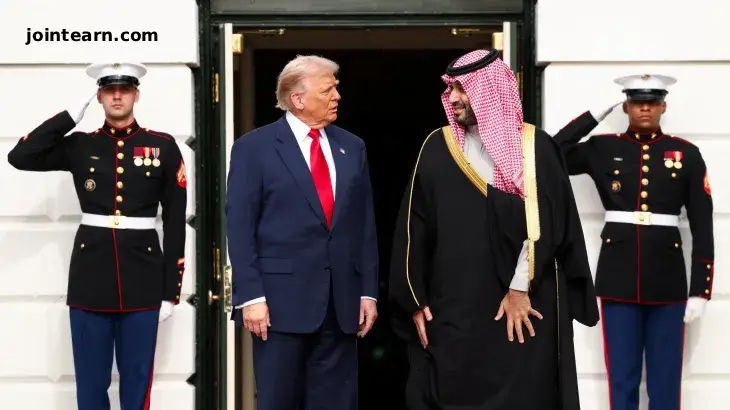
In a landmark shift in Middle East geopolitics, United States President Donald Trump has officially designated Saudi Arabia as a major non-NATO ally (MNNA)—a move that cements decades of strategic cooperation and unlocks sweeping military, economic, and technological partnerships between Washington and Riyadh.
The announcement came during Saudi Crown Prince and Prime Minister Mohammed bin Salman’s high-profile visit to Washington, DC, where both sides celebrated agreements covering defence, civil nuclear energy, artificial intelligence collaboration, and critical minerals.
The highlight of the visit: Trump’s approval for future deliveries of F-35 stealth fighter jets to Saudi Arabia—an unprecedented step that could reshape military power dynamics in the Middle East.
Historic White House Announcement: ‘Military Cooperation to Even Greater Heights’
During a black-tie dinner at the White House, Trump revealed that the US would elevate its relationship with Riyadh to MNNA status.
“We are taking military cooperation to even greater heights,” Trump said, calling the designation “very important” to Saudi Arabia.
The MNNA status offers significant military, financial, and defence-industrial privileges, though it does not commit the US to provide mutual defence in the event of conflict.
A White House fact sheet described the new bilateral defence agreement as a pillar that:
- Strengthens US-Saudi deterrence across the Middle East
- Facilitates deeper access for US defence companies operating in Saudi Arabia
- Provides burden-sharing funds from Riyadh to offset US defence costs
The agreement signals a renewed US commitment to Saudi Arabia at a time of evolving regional rivalries and great-power competition.
US Approves F-35 Sales to Saudi Arabia in Game-Changing Regional Shift
Trump also confirmed his approval for the future sale of F-35 fighter jets—America’s most advanced stealth aircraft—to Saudi Arabia. Riyadh is reportedly seeking 48 F-35s, along with a purchase of 300 American tanks.
This is the first time the US has opened the door to providing F-35s to Saudi Arabia. Until now, Israel has been the only Middle Eastern country permitted to acquire the aircraft, under longstanding US policy guaranteeing Israel’s qualitative military edge (QME).
The proposed sale sparked immediate debate.
When pressed by Al Jazeera’s Kimberly Halkett about Israel’s concerns, Trump acknowledged Tel Aviv’s unease:
“I know Israel would prefer they receive jets of reduced calibre,” he said.
“But I think both nations are strong allies. As far as I’m concerned, they should both get top of the line.”
According to Al Jazeera’s Alan Fisher, Prince Mohammed’s announcement of nearly $1 trillion in new investments in the United States includes $142 billion earmarked for the F-35 acquisition.
The Israeli government and pro-Israel lobbyists reportedly attempted to block the deal, reflecting deep strategic anxieties about shifting power balances in the region.
Beyond Defence: Expanding Nuclear, Economic, and Technology Cooperation
The visit also produced a joint declaration on civil nuclear energy cooperation, which the White House said establishes the legal foundation for a long-term US-Saudi nuclear partnership.
The agreement is expected to involve:
- US support in developing Saudi civilian nuclear reactors
- Enriched uranium production under strict safeguards
- Transfer of advanced nuclear technologies
Additionally, both nations signed agreements centered on AI development, advanced computing, and critical minerals essential for high-tech industries.
This integrated relationship signals a broad US-Saudi realignment, combining economic modernization with shared regional security aims.
Saudi Arabia, Israel, and the Abraham Accords: Palestinian Statehood Still the Key
Israel has hinted it may support an F-35 deal to Saudi Arabia—but only if Riyadh normalises relations with Tel Aviv under the Abraham Accords.
Prince Mohammed has reiterated that Saudi Arabia is willing to join the accords—and move toward official normalization with Israel—but only after there is a guaranteed and credible path toward a Palestinian state.
“We want to be part of the Abraham Accords,” he said.
“But we must also secure a clear path to a two-state solution.”
The Saudi position aligns with its long-held diplomatic stance: normalization is possible, but Palestinian statehood remains a non-negotiable prerequisite.
A Major Geopolitical Reset in the Middle East
Analysts say that this series of announcements is about much more than defence purchases.
It signals:
- A renewed strategic partnership between Washington and Riyadh
- A potential shift in the Middle East’s military balance
- A possible opening for future US-Saudi-Israel diplomatic coordination
- A signal that Saudi Arabia intends to maintain strong ties with the US while managing relations with China and Russia
As Al Jazeera’s Fisher noted from the White House, the agreements are framed by both governments as part of a political and economic reset with long-term implications.


Leave a Reply