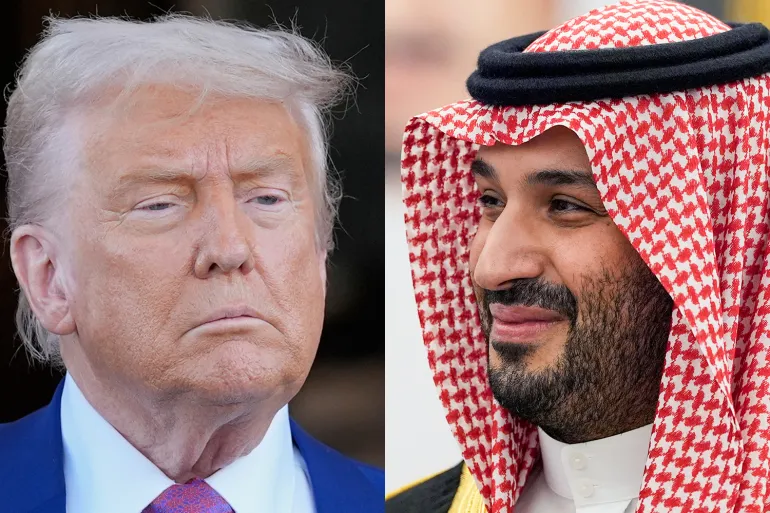
Saudi Arabia’s Crown Prince Mohammed bin Salman (MBS) is visiting Washington for the first time in eight years to meet with former US President Donald Trump. The high-profile meeting is expected to have significant ramifications for Saudi-US relations, regional security, and Middle East diplomacy, particularly in the context of the Abraham Accords and the ongoing Israeli-Palestinian conflict.
When and Where
The meeting took place on November 18, 2025, in Washington, DC. MBS was welcomed with a lavish ceremony, followed by a sit-down discussion in the Oval Office, a signing ceremony for bilateral agreements, and a formal luncheon. Later in the evening, MBS was scheduled to meet members of Congress and leading US business executives at a black-tie dinner in the White House’s East Room.
Key Topics on the Agenda
The visit’s agenda focuses on several strategic areas:
- Trade and Investment – Saudi Arabia holds hundreds of billions in US investments and is expected to announce further deals, particularly in artificial intelligence and civilian nuclear energy.
- Weapons Deals and Defense Cooperation – Trump announced approval of a multibillion-dollar sale of F-35 fighter jets to Saudi Arabia, potentially making it the first Arab nation to acquire this advanced technology. Bin Salman is also expected to seek security guarantees amid growing regional tensions.
- Abraham Accords and Normalization with Israel – Trump aims to encourage Saudi Arabia to join the Abraham Accords, normalizing relations with Israel. However, Saudi officials maintain that such a step will only occur once a credible pathway to Palestinian statehood is established.
- Regional Security – Discussions will likely address Israel’s increasing assertiveness in the region and the need for US-backed security assurances to safeguard Saudi interests.
Historical Context of Saudi-US Relations
Saudi-US relations date back nearly a century, rooted in oil and defense cooperation. The Arabian American Oil Company (Aramco) partnership began in 1933, and the Mutual Defense Assistance Agreement of 1951 formalized US military protection in exchange for reliable oil supplies.
Over the decades, arms sales have grown exponentially. From $14.8 million in 1971–72, Saudi weapons purchases surged to $459 million, coinciding with booming oil exports. This year alone, Saudi Arabia has committed to $142 billion in arms and defense equipment.
The relationship frayed during the Biden administration following the assassination of journalist Jamal Khashoggi in 2018. Although MBS denied direct involvement, the incident strained ties. However, geopolitical shifts, including Russia’s invasion of Ukraine, have renewed strategic alignment between the US and Saudi Arabia.
Trade and Investment Highlights
Saudi-US trade has expanded significantly, with investments totaling $600 billion in January 2025. Key areas include:
- $20 billion investment in AI and data centers in the US
- US companies, such as Hill International, Jacobs, and Parsons, securing infrastructure projects in Saudi Arabia
- Mega projects including the King Salman International Airport and additional $2 billion infrastructure ventures
Despite growing economic ties, Saudi Arabia continues to pursue a comprehensive security pact requiring US defense support in the event of regional threats.
Potential Outcomes and Regional Impact
While full normalization under the Abraham Accords is unlikely during this visit, and the US may not deliver a complete security agreement, the meeting signals a renewed strategic partnership. MBS’s visit reinforces Saudi Arabia’s central role in Middle East geopolitics and may influence US policy toward Palestine, Lebanon, and Syria, including Trump’s recent decision to lift certain sanctions on Syria.
The meeting underscores the enduring influence of Saudi-US relations, the kingdom’s ongoing diversification of investments, and the complex balancing act in regional diplomacy, security, and economic cooperation.


Leave a Reply