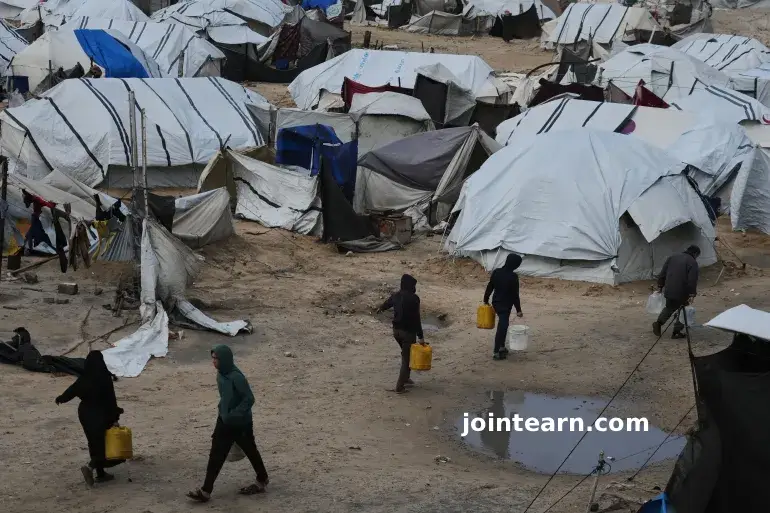
Gaza Strip / Palestine – For the people of Gaza, peace feels far from reach. While a ceasefire has technically been in place since October 10, 2025, Israel continues to conduct sporadic attacks, leaving more than 450 Palestinians dead in the three months since. Amid this backdrop, the United States announced the second phase of the Gaza ceasefire, which includes the creation of a Palestinian technocratic administration supervised by an international “Board of Peace”, chaired by US President Donald Trump.
Palestinians See the Plan Through a Lens of Experience
Many Gazans view these externally imposed solutions with cautious optimism but deep scepticism. The war of October 2023 onward has left thousands displaced, homes destroyed, and essential services in ruins.
“A lot of political decisions are distant from the reality faced in Gaza… our daily life that is filled with blockades, fear, loss, tents, and a terrible humanitarian situation,” said Arwa Ashour, a freelance journalist in Gaza City.
While the Board of Peace promises reconstruction, demilitarization, and technocratic governance, residents question whether it can address the immediate humanitarian and political challenges.
“People want everything back like it was before the war: schools, hospitals, travel. If the Board of Peace is going to resolve all these crises, then we welcome it. But if it’s unable to do so, then what is its benefit?” Ashour added.
Governance and Exclusion Concerns
The new Palestinian technocratic committee will be led by Ali Shaath, a former Palestinian Authority deputy minister, managing daily operations in Gaza. However, the Board of Peace retains ultimate authority, overseen internationally by Bulgaria’s former diplomat Nickolay Mladenov.
Human rights advocates warn that decisions made without meaningful local participation may perpetuate existing power imbalances:
“Excluding Palestinians in Gaza from shaping their future strips them of agency and turns reconstruction and governance into tools of control rather than recovery,” said Maha Hussaini, head of media at Euro-Med Human Rights Monitor.
Justice remains central to Palestinians’ understanding of peace. Hussaini emphasized that recognizing harm, restoring rights, and holding perpetrators accountable are essential for any sustainable resolution.
“Peace does not mean silence after bombardment, nor a pause between wars… Without justice, what is called ‘peace’ becomes only a temporary arrangement that leaves the genocide intact.”
Demilitarization and Reconstruction Challenges
The US and Israel insist on Hamas demilitarization, a step Hamas considers an internal Palestinian matter. Analysts predict this requirement will complicate reconstruction and border access:
“Israel might attach the demilitarization to the opening of crossings, and investments in education and health,” said Ahmed Fayyad, Palestinian political analyst.
The plan’s lack of clarity on timelines and mechanisms for creating a compliant Palestinian security force risks delaying improvements in civilians’ day-to-day life.
“This will reflect negatively on the civilians who yearn for an improvement to their daily harsh reality and suffering in tents, amid outbreaks of disease and the collapse of all economic and social life,” Fayyad added.
Daily Life: Survival Over Politics
For ordinary Gazans, the notion of peace is not political—it is physical safety and routine.
Sami Balousha, a 30-year-old computer programmer, has been displaced 17 times during two years of ongoing attacks. For him, peace means waking up without fear of bombing, returning home safely, and maintaining basic routines.
“Tomorrow is far away, and I have no control over it. We’ve been stuck in this loop for two years. The reality has always been strangely hard and unexpected,” Balousha said.
He, like many, feels excluded from international decision-making:
“They don’t have a deep understanding of the Palestinians’ needs in Gaza. I don’t think that we are being listened to seriously.”
Balousha expressed concern that future generations may accept life in tents and fear as normal, losing sight of Gaza’s pre-war normalcy.
“People only want an end to this all, no matter what the solution is, no matter who makes it. All that matters is the end of this misery at any cost. People are tired, so tired of this all, but want to live.”
Conclusion
While the Board of Peace and technocratic committee may bring structural changes, Gazans remain skeptical about its effectiveness in delivering justice, freedom, and real improvement to daily life. The plan’s success depends not only on political implementation but also on addressing the humanitarian crisis, rebuilding infrastructure, and including Palestinians in decisions about their future.
For now, hope in Gaza is fragile, tempered by years of conflict, occupation, and broken promises, yet the desire to survive and reclaim dignity persists.


Leave a Reply