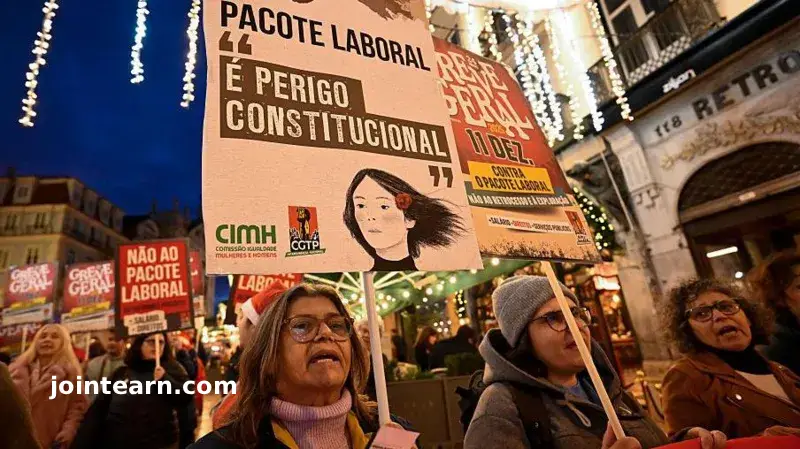
Portugal is experiencing widespread disruption as the country faces its first general strike in 12 years, organized by the nation’s two largest union federations, CGTP and UGT. The strike comes in response to controversial labour reforms proposed by Prime Minister Luís Montenegro’s minority government, affecting workers across multiple sectors, including public transport, schools, hospitals, and major industrial employers.
Nationwide Impact of the Strike
The strike has caused significant interruptions in daily life across Portugal:
- Public transport: Services reduced to minimum levels, with buses, trams, and trains operating only partially.
- Air travel: Dozens of flights cancelled across major airports.
- Healthcare: Hospital operations and non-emergency medical procedures postponed.
- Education: Schools closed in multiple cities.
- Public services: Refuse collection has come to a near standstill.
This day of action is notable for being the first coordinated strike by both CGTP and UGT since 2013, when union federations protested the austerity measures imposed during the Eurozone debt crisis.
Controversial Labour Reforms
Prime Minister Montenegro argues that labour market “rigidities” must be addressed to boost productivity and improve wages. However, unions contend the reforms favour employers at the expense of workers, particularly impacting young people and women.
Among the most contentious measures are:
- Extending temporary contracts indefinitely
- Allowing sacking and immediate rehiring via outsourcing
- Removing the obligation to reinstate unfairly dismissed employees
Union leaders and critics argue these reforms undermine Portugal’s strong employment protections, enshrined in the 1976 constitution.
Public Opinion and Worker Reactions
Reactions to the reforms are mixed:
- Supporters: Some young professionals, like air steward Diogo Brito, believe reforms are necessary for Portugal to catch up with wealthier European nations.
- Opponents: Self-employed workers like photographer Eduardo Ferreira emphasize the lack of job security and welcome the union response.
At VW Autoeuropa, Portugal’s largest factory, nearly 1,000 employees voted unanimously to support the strike, highlighting the broad opposition across sectors.
Political Context and Challenges
Montenegro’s minority government faces challenges in passing the reform bill, relying on support from:
- Liberal Initiative (IL) – small free-market party
- Chega – hard-right party, which has expressed reservations but is open to negotiation
The reforms have also become a central issue in the upcoming January presidential election, with multiple candidates arguing that the labour reform bill violates constitutional protections. Under Portugal’s semi-presidential system, the president can veto legislation, refer it to the Constitutional Court, or delay its implementation, providing additional opportunities for public and political scrutiny.
Union Criticism
Union federations have strongly condemned the reforms:
- CGTP: Called the measures “an assault on workers’ rights, particularly women and young people”
- UGT: Argued the proposals are “out of step with economic growth and financial stability, clearly favouring employers”
UGT secretary-general Mário Mourão emphasized the strike’s significance:
“I believe there is no worker in this country unaffected by the negative measures in this reform. It must be responded to appropriately.”
Potential Consequences
The strike demonstrates widespread worker dissatisfaction with Montenegro’s government and could influence legislative negotiations, public opinion, and the upcoming presidential election. Analysts suggest that the government’s attempt to overhaul Portugal’s labour code without broad consensus may fuel political uncertainty and voter unease.


Leave a Reply