Senegal were crowned champions of the Africa Cup of Nations for the second time in five years after defeating hosts Morocco, but their historic triumph was overshadowed by extraordinary scenes of controversy, protest and crowd unrest that many have described as a “shameful” moment for African football.
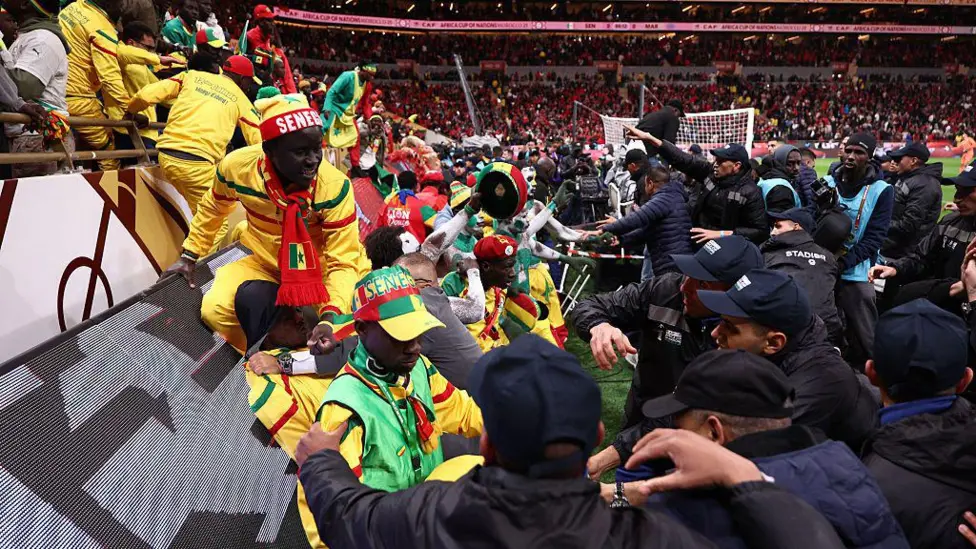
What should have been a celebration of elite football instead descended into chaos when Senegal’s players temporarily refused to continue the match following a dramatic stoppage-time penalty decision, sparking fury on the pitch and unrest in the stands.
A Final That Descended Into Disorder
With the score level at 0–0 deep into stoppage time, referee Jean Jacques Ndala awarded Morocco a penalty in the 98th minute after a VAR review of a challenge by Senegal defender El Hadji Malick Diouf on Brahim Diaz.
Moments earlier, Senegal had a goal disallowed for a foul in the build-up, a decision that left head coach Pape Thiaw visibly furious. The penalty award proved the breaking point.
In an unprecedented move, Thiaw instructed his players to leave the pitch, protesting what they believed were repeated officiating injustices. As players headed toward the tunnel, tensions boiled over in the stands, with angry Senegal supporters clashing with security personnel and attempting to access the pitch.
Former Liverpool star Sadio Mane, however, remained on the field, urging his teammates to return and finish the match, aware of the global audience watching African football’s biggest stage.
After a delay of approximately 17 minutes, Senegal’s players eventually returned.
Penalty Drama and a Stunning Turnaround
Morocco’s talisman Brahim Diaz, the tournament’s top scorer with five goals, stepped up to take the crucial penalty. In a moment that will haunt him, the Real Madrid forward attempted a Panenka, but Senegal goalkeeper Edouard Mendy calmly caught the effort.
The referee immediately blew for full-time, sending the match into extra time.
Just four minutes into the additional period, Pape Gueye struck the decisive goal, sealing a dramatic 1–0 victory and confirming Senegal as AFCON champions once again, having previously lifted the trophy in 2021.
Strong Condemnation From Morocco and FIFA
Morocco head coach Walid Regragui did not hide his anger after the match, describing Senegal’s decision to leave the field as:
“Shameful. It does not honour Africa.”
FIFA president Gianni Infantino, who was present at the final, issued a scathing statement on Instagram, condemning the “ugly scenes” that unfolded.
“It is unacceptable to leave the field of play in this manner. Violence cannot be tolerated in our sport. The decisions of match officials must always be respected, because anything less puts the very essence of football at risk.”
Infantino added that the incident “must never be repeated” and called on CAF’s disciplinary bodies to take appropriate action.
The Confederation of African Football (CAF) echoed those sentiments, confirming that it is reviewing all footage and will refer the matter to disciplinary committees.
Senegal Coach Apologises After Emotions Boil Over
Pape Thiaw’s post-match press conference was cancelled after disorder broke out in the media room, but the Senegal coach later addressed the situation in an interview with beIN Sports.
“We didn’t agree. I apologise for football,” Thiaw said.
“You can react in the heat of the moment. After reflecting, I made them come back. We accept the referee’s errors — but we shouldn’t have done it.”
Thiaw acknowledged that ordering his team off the pitch was wrong, despite the frustration over the disallowed goal and the penalty decision.
Players Speak Out: Pride, Regret, and Responsibility
Mane was candid in his post-match comments, emphasizing the importance of setting an example.
“Football is something special. The world was watching, so we have to give a good image. I’d rather lose than see something like this happen to our football.”
Goalkeeper Edouard Mendy, now playing for Al-Ahli in Saudi Arabia, said he was proud of how the team regrouped.
“We did it together and we came back together. That’s all that matters.”
Match-winner Pape Gueye added:
“We felt injustice. But Sadio told us to come back. Edouard made the save, we stayed focused, and we won.”
A Tournament Ending on a Sour Note
BBC World Service reporter John Bennett, watching from the commentary box, described the scenes as “astonishing” and deeply damaging to the tournament’s legacy.
“It’s an awful way for a tournament that had been a great advert for African football to end. With four years until Morocco co-hosts the World Cup, these scenes may be what people remember most.”
Former Nigeria internationals Efan Ekoku and John Obi Mikel both criticised Senegal’s actions, calling the walk-off “not a good look for African football,” even while acknowledging the frustration surrounding the penalty decision.
Pre-Final Tensions Added Fuel to the Fire
In the days leading up to the final, Senegal had raised concerns over security arrangements, ticket allocations and training facilities, claiming their players were put “at risk” when fans swarmed their team bus in Rabat.
Those grievances, combined with a tournament already marked by debates over VAR and refereeing, created a volatile atmosphere that exploded during the final.
Senegal Champions, But Questions Remain
Despite lifting the trophy, Senegal’s victory will forever be linked with controversy. Their footballing achievement — becoming AFCON champions again — is undeniable, but the chaotic scenes have triggered serious conversations about officiating, discipline, and responsibility in African football.
As CAF reviews the incident and potential sanctions loom, one thing is clear: Senegal won the title, but the final left scars that will take far longer to heal than the celebrations will last.


Leave a Reply