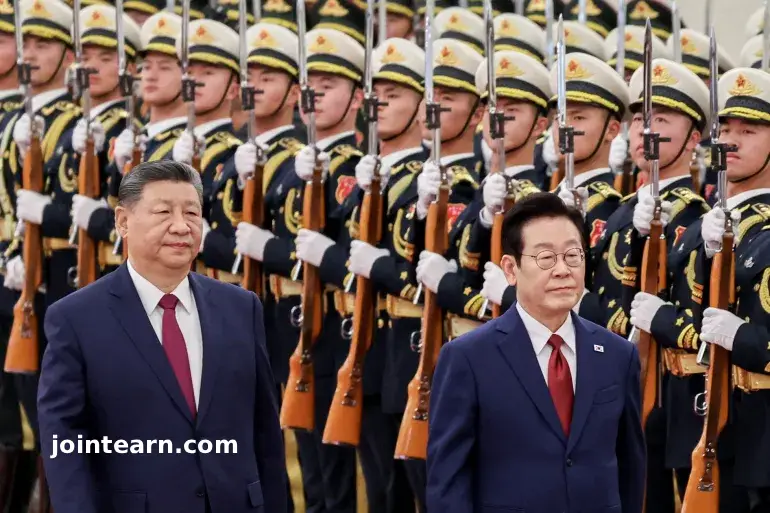
South Korean President Lee Jae Myung has publicly called for a freeze on North Korea’s nuclear programme, urging Beijing to play a key mediation role in easing tensions on the Korean Peninsula and restarting stalled negotiations with Pyongyang. The appeal came during a landmark state visit to China — the first by a South Korean leader in six years — as Seoul seeks new diplomatic avenues to address one of East Asia’s most persistent security challenges.
Seoul’s Strategic Proposal: Nuclear Freeze in Exchange for Compensation
Addressing journalists in Shanghai at the conclusion of his four‑day visit to China, President Lee set out his proposal for dealing with North Korea’s growing nuclear arsenal. He suggested that Pyongyang freeze its nuclear programme — halting further production of nuclear weapons, stopping the transfer of nuclear materials abroad, and ending the development of intercontinental ballistic missiles (ICBMs) — in return for compensation or some form of international incentives.
Lee emphasized that achieving such a freeze would be a meaningful step forward, even if it does not represent full denuclearization. “Just stopping at the current level … would already be a gain,” he said, adding that in the medium term gradual reductions could follow, and that in the long term South Korea must continue to pursue the ultimate goal of a nuclear‑free Korean Peninsula.
Beijing Asked to Mediate After Communication Breakdowns
One of the central themes of Lee’s visit was a renewed effort to reset ties between Seoul and Beijing and to enlist China’s influence in dialogue with the North. Lee told Chinese President Xi Jinping that all communication channels between South and North Korea have been blocked, describing relations as characterized by “zero trust.” As a result, he urged China to serve as a mediator for peace, particularly on the nuclear issue.
China, North Korea’s most significant diplomatic backer and largest trading partner, responded to the request by calling on Seoul to show “patience” in handling Pyongyang, given the “fraught” nature of inter‑Korean ties. Beijing’s response underscores its cautious stance in balancing regional stability with its strategic relationship with Pyongyang.
Context: Nuclear Standoff and Missile Tests
Lee’s diplomatic overtures coincide with renewed military activity by North Korea. Just prior to the summit, Pyongyang conducted ballistic missile launches into the Sea of Japan, a demonstration of capability that further highlights tensions on the Korean Peninsula. Seoul and neighboring countries condemned the tests as violations of United Nations resolutions and a challenge to regional security.
North Korea has consistently expanded its nuclear and missile programmes since the collapse of earlier talks in 2019, rejecting outside pressure to denuclearize and instead emphasizing nuclear weapons as essential to its regime’s survival.
Seoul’s Broader Diplomatic Goals With Beijing
Beyond the nuclear issue, Lee’s visit to China aimed to reset a relationship that has been strained in recent years. Tensions had deepened after disagreements over the deployment of a U.S. missile defence system in South Korea in 2017 led to restrictions on South Korean cultural exports and slowed broader cooperation. Lee’s meetings with President Xi marked a concerted effort to rebuild trust between the two capitals and expand cooperation on broader regional security issues.
Challenges Ahead for Diplomacy on the Peninsula
Analysts caution that any freeze agreement will be difficult to negotiate and may not immediately lead to verifiable reductions in North Korea’s arsenal. Past rounds of nuclear diplomacy have repeatedly stalled, and experts warn that without strong enforcement mechanisms and mutual trust, Pyongyang may refuse to make significant concessions. Moreover, some fear that offering incentives for a freeze could allow North Korea to retain much of its nuclear capability while gaining economic or diplomatic benefits.
Despite these obstacles, Seoul’s Sudanese strategy suggests a desire to explore incremental steps — starting with a freeze and potentially leading to more substantial progress over time. The involvement of China, given Beijing’s unique relationship with Pyongyang, is seen as key to reviving meaningful negotiations that have been dormant for years.
Looking Forward: A Fractured But Urgent Diplomatic Landscape
As South Korea and China work to strengthen diplomatic engagement, the Korean Peninsula remains at a crossroads. Lee’s outreach to Xi Jinping represents a significant diplomatic push to find alternative paths to peace and stability — paths that may require patience, realism, and a willingness to pursue incremental steps toward denuclearization. Whether Beijing will play a decisive mediating role remains a central question for regional security in 2026 and beyond.


Leave a Reply