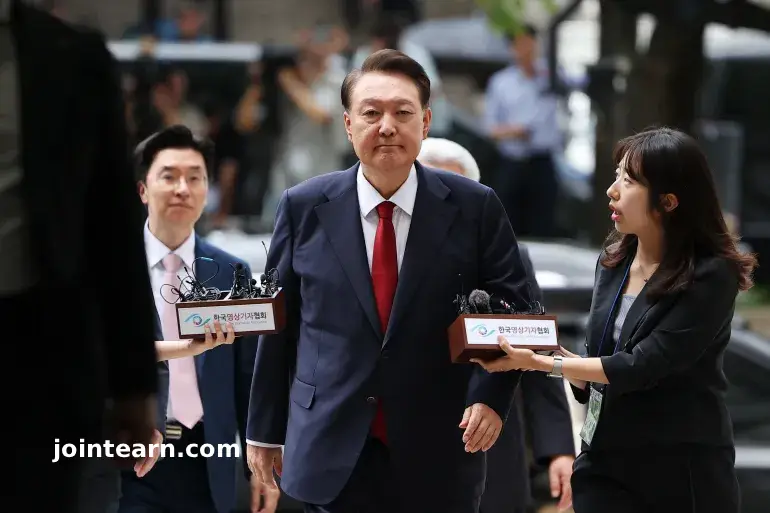
South Korean prosecutors have formally indicted former President Yoon Suk Yeol on charges of insurrection, accusing him of orchestrating a long-running plot to provoke military aggression from North Korea as a pretext to impose martial law and consolidate his political power.
The indictment marks one of the most serious political prosecutions in South Korea’s modern history and follows a six-month investigation into Yoon’s failed declaration of martial law in December 2024 — a move that plunged the country into constitutional crisis.
Prosecutors Allege Plot to Provoke North Korea
Special Prosecutor Cho Eun-seok announced on Monday that Yoon, along with five former cabinet ministers and 18 additional individuals, has been charged with insurrection. Prosecutors allege the group deliberately sought to inflame tensions with Pyongyang in order to justify emergency rule.
“To create justification for declaring martial law, they attempted to lure North Korea into mounting an armed aggression,” Cho said. “The plan ultimately failed because North Korea did not respond militarily.”
According to the indictment, the alleged provocations included military manoeuvres and covert actions designed to escalate tensions on the Korean Peninsula, with the expectation that a hostile response from the North would provide legal and political cover for suspending democratic governance.
Martial Law Declaration Triggered Political Uprising
Yoon’s surprise declaration of martial law in December 2024 sparked mass protests across South Korea and prompted lawmakers to rush to parliament in order to overturn the decree. The move was swiftly ruled unconstitutional by the Supreme Court, and Yoon was subsequently impeached, removed from office, and jailed.
The crisis deeply polarised South Korean society and raised alarm among international observers about the stability of one of Asia’s strongest democracies.
Plot Allegedly Planned for Over a Year
Prosecutor Cho revealed that the planning behind the martial law declaration dated back to October 2023, more than a year before Yoon acted.
Investigators say the former president and his allies:
- Installed loyalists in key military positions
- Removed officials opposed to emergency rule
- Held private meetings and dinners with senior military figures to build support
- Issued military directives aimed at provoking North Korea
Among those implicated are former Defence Minister Kim Yong Hyun and Yeo In-hyung, the former head of military counterintelligence.
Drone Incidents and Propaganda Campaigns
Yoon was also indicted last month for allegedly ordering drone flights carrying propaganda leaflets into North Korea, an act prosecutors say was intended to inflame tensions. The revelation led current President Lee Jae Myung to publicly state that he was considering a diplomatic apology to Pyongyang to stabilise relations.
Prosecutors believe North Korea’s muted response was partly due to its military focus on supporting Russia’s war in Ukraine, which reduced the likelihood of escalation on the Korean Peninsula.
Political Opponents Branded ‘Anti-State Forces’
Despite the lack of a military response from the North, Yoon allegedly pressed forward with his plans, publicly branding political opponents — including members of his own conservative party — as “anti-state forces.”
Cho stated that the goal was to justify sweeping authoritarian measures and eliminate political resistance.
“Yoon declared emergency martial law to monopolise and maintain power by taking control of the legislative and judiciary branches and eliminating political opponents,” Cho said.
Severe Penalties Under South Korean Law
Under South Korean law, insurrection carries penalties ranging from life imprisonment to the death penalty. Yoon has been in jail since July 2025 following earlier periods of detention and continues to deny wrongdoing.
His legal team maintains that the martial law declaration was a political strategy aimed at countering opposition obstruction in parliament, rather than an attempt to dismantle democracy.
A Defining Moment for South Korea’s Democracy
The indictment represents a defining moment for South Korea’s political system, testing the strength of its legal institutions and democratic safeguards. Observers say the case could reshape civil-military relations and set lasting precedents for accountability at the highest levels of power.


Leave a Reply