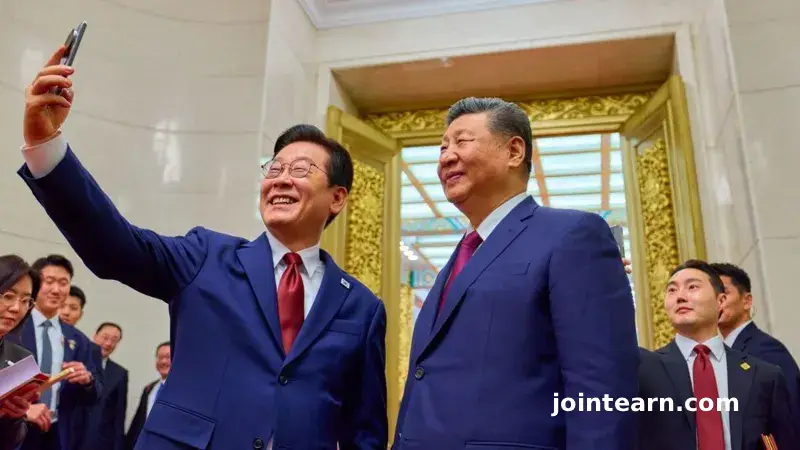
South Korean President Lee Jae Myung has called for a “new phase” in relations with China during his historic visit to Beijing, marking the first trip by a South Korean leader since 2019. The visit comes at a time of heightened geopolitical tension in Northeast Asia, following North Korean missile tests and US operations in Venezuela, as well as longstanding friction over cultural and economic issues between Seoul and Beijing.
High-Level Meetings and Diplomatic Agenda
During his four-day visit, Lee met Chinese President Xi Jinping in Beijing, taking selfies to highlight their personal rapport. The South Korean leader is also scheduled to meet Premier Li Qiang and Zhao Leji, chairman of China’s National People’s Congress, signaling efforts to strengthen high-level political and economic dialogue.
Lee emphasized that the visit represents “a crucial opportunity” to fully restore South Korea-China relations and “usher in a new phase in the development” of bilateral ties. Government officials and business representatives from both countries signed agreements covering technology, trade, and environmental cooperation.
Xi highlighted the increasing complexity of the international situation, urging Lee to “stand on the right side of history and make correct strategic choices,” according to China’s Xinhua news agency. Xi also referenced the shared history of resisting Japanese militarism and stressed the importance of regional peace and stability in Northeast Asia.
Security and North Korea
Security concerns on the Korean Peninsula were central to discussions. Lee has sought to engage North Korea diplomatically, aiming to pressure leader Kim Jong Un toward denuclearization. Cooperation with China is critical, as Beijing remains a primary economic and diplomatic supporter of Pyongyang.
The visit coincided with North Korea’s recent ballistic and hypersonic missile tests, which may have been influenced by US military operations in Venezuela. Lee emphasized working with China to identify “viable alternatives for peace on the Korean Peninsula,” though analysts note that progress may be limited given Beijing’s traditional support for Pyongyang.
Economic and Cultural Priorities
China remains a vital trade partner for South Korea, while also imposing unofficial restrictions on Korean pop culture, including K-pop and K-dramas, in place for more than a decade. These restrictions are widely believed to be linked to South Korea’s deployment of a US anti-missile system in 2016, which China perceives as a regional threat.
Lee’s visit promoted deeper cultural and economic exchanges, including in entertainment, food, and beauty industries. Both sides pledged to pursue “orderly, healthy, and beneficial cultural exchanges,” signaling a possible easing of restrictions on South Korean media content in China.
Balancing Relations with China, Japan, and the US
South Korea’s strategic position requires balancing relations between China, the United States, and Japan. Lee is reportedly planning a visit to Japan later this month to meet Prime Minister Sanae Takaichi, amid tensions with Beijing over Tokyo’s proposed self-defense measures concerning Taiwan.
Analysts note that while South Korea demonstrates deference to China, it seeks to maintain strong ties with Japan and the US, particularly regarding regional security and military cooperation. South Korea and the US recently agreed to collaborate on nuclear-powered submarines, a move that drew concern from Beijing.
Outlook for South Korea-China Relations
Lee described his trip as a “new starting point to fill in the gaps in Korea-China relations, restore them to normal, and upgrade them to a new level.” The visit signals Seoul’s intent to strengthen bilateral ties through diplomacy, trade, and culture, while carefully navigating security and geopolitical challenges in the region.
With North Korea’s nuclear program, the US’s influence in Asia, and China’s regional ambitions, Lee’s diplomatic balancing act highlights the complexities of South Korea-China relations in 2026.


Leave a Reply