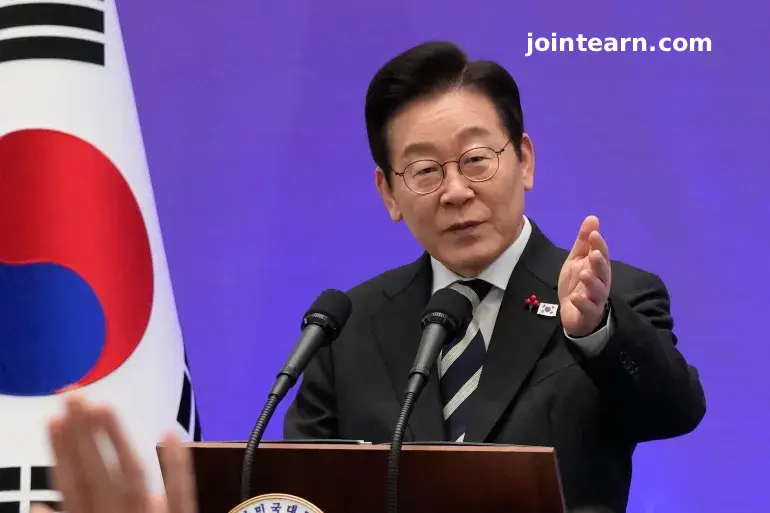
South Korean President Lee Jae Myung has signaled that he is considering issuing an official apology to North Korea following new allegations that his predecessor, former President Yoon Suk-yeol, authorized drone-based propaganda operations aimed at escalating tensions on the Korean Peninsula.
Speaking at a press conference in Seoul on Wednesday, President Lee reflected on the political crisis triggered by Yoon’s actions and the ongoing fallout from the former leader’s indictment.
Drone Flights Spark Political and Regional Tension
Yoon Suk-yeol was formally charged last month for allegedly ordering a series of drone flights carrying propaganda leaflets into North Korean airspace in 2024. Prosecutors believe the operation was intended to provoke Pyongyang and strengthen Yoon’s political position during a period of domestic uncertainty.
North Korea accused Seoul of conducting at least three drone incursions in October 2024, claiming the aircraft dropped anti-Pyongyang materials near the capital. Additional reports from South Korean media this week also suggest that the South’s military deployed balloon-launched leaflets along the border during the same period.
Lee Jae Myung: Torn Between Diplomacy and Domestic Backlash
President Lee, who took office earlier this year after winning a snap election triggered by Yoon’s impeachment, said he felt moral responsibility to address the provocations publicly.
“I feel I should apologise, but I hesitate to say it out loud,” he said.
“I’m concerned that doing so could inflame ideological divisions or lead to accusations of being sympathic to the North.”
Lee has repeatedly emphasized dialogue and de-escalation since assuming office in June 2025. But despite his outreach, North Korean leader Kim Jong Un has not responded to any of his diplomatic overtures.
Anniversary of the Martial Law Crisis
Lee’s remarks came on the anniversary of Yoon’s attempt to impose martial law, a dramatic and controversial move that plunged South Korea into one of its most intense political crises in decades.
The declaration led to mass demonstrations, lawmakers physically blocking parliament, and a swift ruling by the Supreme Court that deemed the move unconstitutional. Yoon was later impeached, removed from office, and now awaits trial on charges including insurrection.
South Korea remains sharply divided over the episode, with supporters of Yoon holding out that his hardline strategy on North Korea was justified, while opponents view it as an unprecedented attack on democratic institutions. Rival protest groups marched through Seoul on Wednesday as the nation reflected on the politically turbulent episode.
Efforts to Rebuild Inter-Korean Relations
Since becoming president, Lee has taken multiple steps to reduce hostility along the border:
- Removing anti-North Korean loudspeakers
- Supporting legislation banning private activists from sending leaflet balloons
- Opening the door to scaled-back South Korea–US military drills, which North Korea routinely condemns as preparation for invasion
Lee told reporters he remains committed to finding a diplomatic pathway forward despite North Korea’s silence.
He also expressed hope that US President Donald Trump, whom he described as “a realist and master negotiator,” could help bring Pyongyang back to the table. North Korea has historically paid closer attention to dialogue with Washington than with Seoul, he noted.
A Delicate Balancing Act Ahead
While Lee continues to push for improved relations, the political atmosphere inside South Korea remains deeply polarized. Any hint of conciliatory language toward the North carries domestic political risk.
Even so, Lee insisted he would “keep working to ease tensions” and explore every possible avenue for restarting dialogue — including controversial steps such as adjusting joint military exercises with the United States.


Leave a Reply