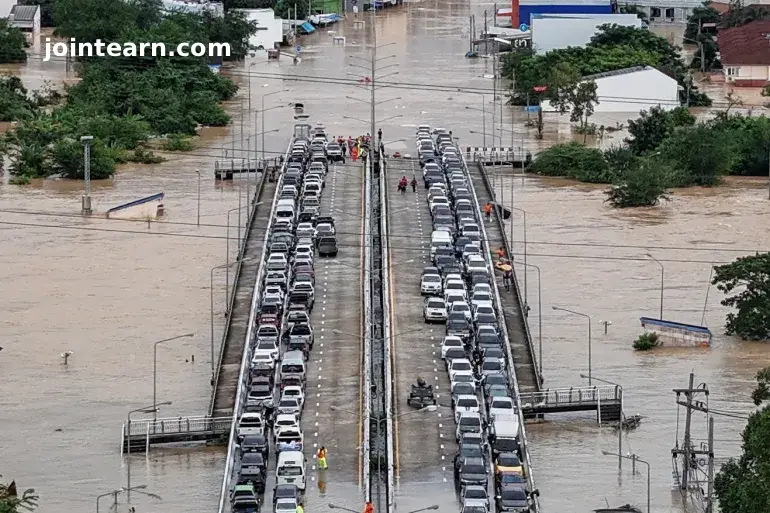
Southern Thailand is facing one of its worst flood disasters in years, with at least 13 people killed and tens of thousands stranded after torrential rains submerged entire towns across the southern provinces. Officials confirmed that Songkhla province has been officially declared a disaster zone as rescue operations intensify in severely affected districts.
The city of Hat Yai, a major urban hub in the region, recorded a historic 335mm (13 inches) of rainfall in a single day—its highest level in almost 300 years. The unprecedented downpour left large areas underwater, prompting disaster teams, volunteers, and the Thai military to launch large-scale rescue missions.
Floodwaters Reach 2 Meters as Government Declares Emergency Zone
Drone footage from Hat Yai revealed cars parked on bridges for safety as rising water swallowed roads, homes, and marketplaces. In several neighborhoods, water levels surged to two meters, trapping families inside homes and leaving communities without power or essential supplies.
Thailand’s Disaster Prevention and Mitigation Department confirmed that 13 fatalities had occurred by Tuesday, and thousands more remain unreachable due to flooding, damaged roads, and widespread power cuts.
According to climate specialist Seree Supratid of Rangsit University, more than 150,000 people in Hat Yai alone have been affected, many of whom remain stranded without access to food, clean water, or communication.
The government quickly approved a disaster declaration for Songkhla to accelerate emergency funding and resource allocation as the situation continues to deteriorate.
Nine Provinces Impacted, Millions Affected
At least nine southern provinces have been hit by relentless rainfall, affecting 2.1 million people. Reuters reports that more than 13,000 residents have already moved into emergency shelters, while many others remain isolated and unable to receive help as floodwaters continue to rise.
Factories and industrial sites have also been flooded, causing disruptions across a region known globally for rubber production. Industry Minister Thanakorn Wangboonkongchana confirmed that 17 power plants were forced offline due to flood damage, raising concerns about prolonged outages and supply chain disruptions.
Thai Military Deploys Massive Rescue Effort
As local rescue teams became overwhelmed by nonstop emergency calls, Thailand’s military escalated its response. A C-130 cargo aircraft was deployed, carrying essential supplies such as medicine, food, drinking water, and emergency equipment.
The aircraft carrier Chakri Naruebet sailed to the region with:
- Two helicopters
- Medical teams
- Field kitchens capable of preparing 3,000 meals a day
- Additional personnel to support rescue workers
The Royal Thai Navy stated the vessel could also serve as a floating hospital if land-based facilities became inaccessible.
Emergency hotlines and rescue groups in Hat Yai reported that over the last three days, thousands of distress calls poured in from residents begging for help. Social media pages filled with messages from people trapped in their homes, with many reporting that floodwaters had reached their second floors and communication lines were failing.
Northern Malaysia Also Flooded as Rains Spill Across Border
The same monsoon system has caused severe flooding in northern Malaysia, where more than 19,000 residents have been evacuated to 126 emergency shelters. The states of Perlis and Kelantan, both bordering Thailand, reported widespread flooding, with rescue teams navigating knee-deep waters to reach stranded families.
Malaysian Prime Minister Anwar Ibrahim urged residents to follow evacuation orders and offered prayers for those affected, emphasizing the need for resilience during this “difficult and challenging time.”
Regional Impact and Ongoing Threat
With heavy monsoon rains expected to continue, authorities warn that water levels may rise further, increasing the risk of landslides, power failures, and additional displacement.
Southern Thailand and northern Malaysia regularly experience seasonal flooding, but experts say climate change is intensifying storms and increasing rainfall volume, making disasters like this more frequent and severe.


Leave a Reply