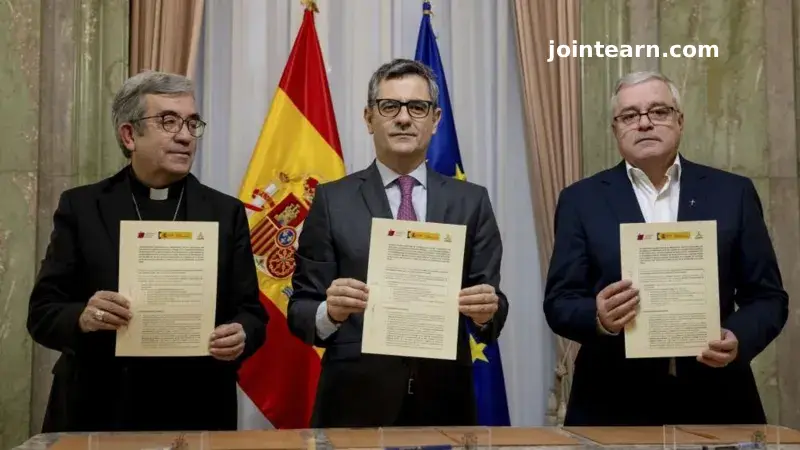
Spain’s Roman Catholic Church has signed a historic agreement with the government to compensate victims of sexual abuse by members of the clergy. The deal comes after years of complaints that the Church failed to adequately address widespread abuse and ensure justice for survivors.
Under the new framework, the government will coordinate compensation with the Church for cases where other legal avenues are no longer available—either because the alleged crime occurred too long ago or the accused has passed away.
“A democracy should not allow the existence of victims who have never been compensated, whose situation had been covered up,” said Justice Minister Félix Bolaños. He added that the agreement aims to “pay off a historic, moral debt” to survivors of clerical abuse.
Key Figures Behind the Agreement
The deal was signed by:
- Luis Argüello, president of the Episcopal Conference and leader of the Spanish Catholic Church
- Jesús Díaz Sariego, president of Confer, representing Catholic congregations and religious orders
- Justice Minister Félix Bolaños, representing the Spanish government
Sariego described the initiative as unprecedented, particularly because it addresses crimes that have gone past the statute of limitations. Argüello called it “another step forward along the path” the Church has been taking to confront abuse.
Scale of the Abuse
A 2023 study by Spain’s ombudsman estimated that 1.1% of the population, or roughly 440,000 people, had suffered sexual abuse at the hands of clergy or Church-affiliated individuals. While the Church has contested these figures, it established a reparation scheme in 2023 to manage claims.
Critics argued the Church’s previous framework lacked transparency and external oversight, resolving only 58 cases by November 2025. Media investigations, such as those by El País, have documented nearly 3,000 victims dating back to the 1940s.
Several victims’ groups broke ties with the Spanish Church in 2025, citing exclusion from reparations. The Vatican subsequently intervened, urging Spanish Church leaders to strengthen compensation mechanisms.
How the New System Works
Victims can now submit claims to a new agency created by the Justice Ministry, which will present them to the ombudsman. The ombudsman will propose a reparation plan, which the Church must approve. If the Church refuses, the case returns to the ombudsman for resolution.
Compensation may be:
- Symbolic
- Psychological
- Economic
The exact financial amounts have not been disclosed, but Spain is expected to follow precedents set in other European countries. For instance, Belgium has provided €6,000 per victim, while Ireland’s redress board averages €63,000 per survivor.
Historical Context
Sexual abuse by clergy gained global attention in the 1980s, first in the US and Canada, later spreading to Argentina, Australia, and Ireland. Spain, as a traditionally Catholic country, saw relatively few high-profile scandals until recent media investigations revealed widespread historical abuse.
A recent case involved the bishop of Cádiz, Rafael Zornoza, who resigned in November 2025 following allegations dating back to the 1990s.
Reaction from Victims’ Groups
Victims’ organisations have welcomed the deal, describing clerical sexual abuse as a “structural, endemic evil” the Church should have confronted decades ago.
“This is an endemic, structural evil which has been within the Church and which it should have tackled a long time ago instead of covering up paedophiles,” said Juan Cuatrecasas, of the Association for Stolen Childhood (Anir).
Moving Forward
The new agreement marks a significant milestone for Spain, offering a coordinated, transparent path for victims to receive compensation while ensuring the Church takes responsibility. It is part of broader efforts across Europe to address historical abuse and provide justice to survivors.


Leave a Reply