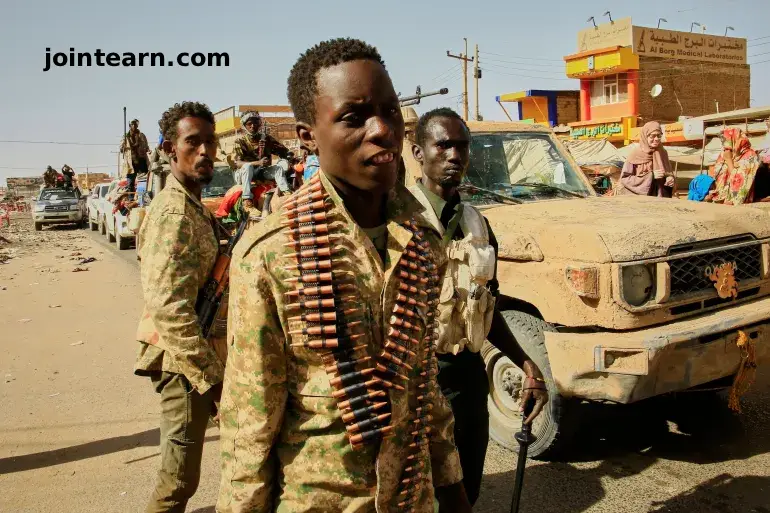
The Sudanese Armed Forces (SAF) has officially rejected claims by the paramilitary Rapid Support Forces (RSF) that it has taken control of the strategically significant West Kordofan town of Babnusa, a city that serves as a gateway to the western region of Sudan, including Darfur.
The military government released a statement on Tuesday asserting that it had successfully repelled an RSF attack on Babnusa, countering the paramilitary’s announcement the previous day. The RSF had claimed full control of the town, which is considered crucial for controlling central Sudan.
Babnusa: A Strategic Gateway
Babnusa’s location makes it a vital hub for military and economic movements in Sudan. Analysts warn that if the RSF consolidates power there, it would not only solidify its presence in West Kordofan but also control key access routes to western Sudan, including Darfur.
Al Jazeera correspondent Hiba Morgan reported from Khartoum that while SAF forces continue to fight in the city, the RSF has taken parts of the army headquarters in Babnusa. “The army maintains its presence inside the city, but control of key facilities has shifted to the RSF,” Morgan said.
The SAF spokesperson confirmed, “The RSF launched a new attack on Babnusa, which our forces decisively repelled. Battles are ongoing, and our soldiers remain in the city.”
Rising Tensions Across Kordofan
The conflict in Babnusa reflects the broader struggle across Sudan’s Kordofan regions. Fierce clashes are also reported in Abbasiya Tagali and other parts of southern Kordofan. The RSF’s recent advances follow its capture of el-Fasher, the army’s last stronghold in Darfur, marking a critical shift in territorial control.
Witnesses and international aid agencies have documented widespread atrocities during RSF operations, including mass killings, kidnappings, and sexual violence, adding to the humanitarian crisis in the region.
Ceasefire Breakdown
The ongoing fighting undermines a unilateral ceasefire announced by the RSF, following mediation by the “Quad”—Egypt, Saudi Arabia, the UAE, and the United States. The SAF rejected the ceasefire as overly favorable to the RSF, accusing the paramilitary of continuing attacks despite the truce.
A Sudanese government statement described the ceasefire as “a political and media ploy intended to mask RSF movements and the flow of foreign support fueling the war,” implicitly referencing UAE backing. Although the UAE denies involvement, analysts argue that foreign support has played a critical role in sustaining RSF operations.
Implications for Sudan’s War
If Babnusa falls completely to the RSF, experts predict the group may advance toward el-Obeid in North Kordofan, further threatening SAF control. Kholood Khair, founding director of Confluence Advisory, explained that Babnusa is “a major mercantile center and regional capital. Its capture would represent both an economic and strategic victory for the RSF and bring them closer to Khartoum.”
The SAF had regained some momentum earlier in the war, pushing the RSF out of Khartoum in March. However, recent losses in Darfur and potential setbacks in Kordofan suggest the conflict’s momentum may be shifting again in favor of the RSF.
Political analysts like Dallia Abdelmoniem note that the RSF is leveraging alliances with groups such as SPLM-N, which controls South Kordofan’s Nuba Mountains, to strengthen its position across Sudan.
Humanitarian Concerns
Amid these ongoing clashes, civilians continue to face dire conditions. Reports indicate thousands of children are fleeing conflict zones, and communities in neighboring countries, including Chad, are grappling with the trauma and displacement caused by wartime violence.
The situation in Babnusa and West Kordofan remains fluid, with both sides reporting ongoing skirmishes. Observers warn that the next few weeks could determine control over central and western Sudan, influencing the broader trajectory of the Sudan conflict in 2025.


Leave a Reply