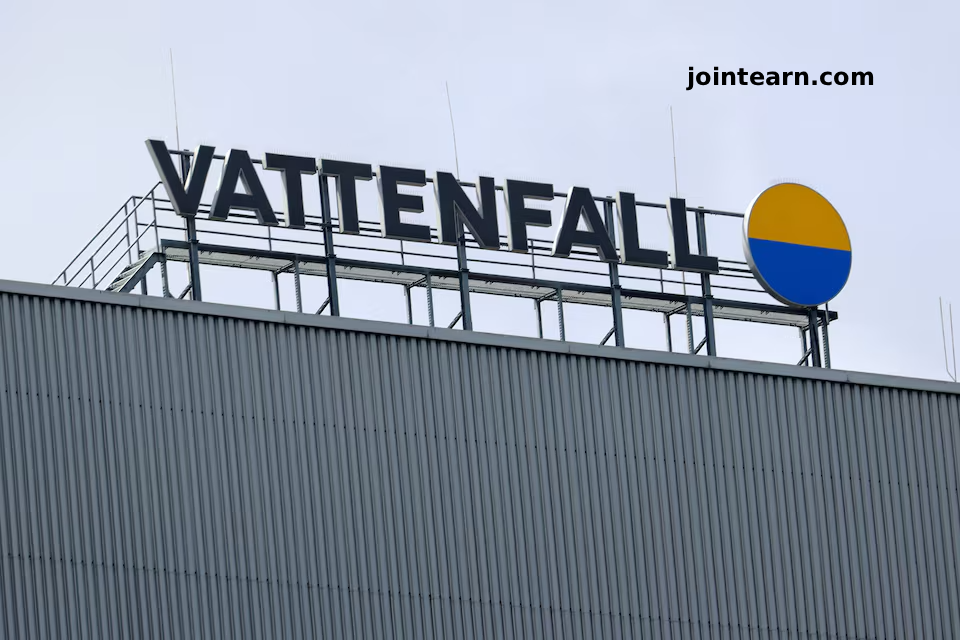
Sweden’s state-owned utility Vattenfall AB has formally applied for government financing to construct new nuclear reactors at its Ringhals nuclear power plant, marking a critical step in the Scandinavian country’s plan to rejuvenate its nuclear energy sector.
Plans for Small Modular Reactors (SMRs)
Vattenfall, through its majority-owned subsidiary Videberg Kraft, intends to build small modular reactors (SMRs) at the site of the existing Ringhals facility in southwestern Sweden. These reactors are designed to be more flexible and cost-effective than traditional large-scale nuclear plants.
“State support will be critical for the project,” said Desiree Comstedt, head of new nuclear power at Vattenfall. The project is part of Sweden’s broader goal to achieve fossil-free electricity production to support the electrification of transport and industry.
The Swedish government confirmed that financing arrangements, including size, conditions, and potential risk-sharing, will be negotiated with Vattenfall and must be approved by the European Commission.
Government’s Nuclear Ambitions
Sweden’s current administration has committed to reviving the country’s nuclear power sector. The government envisions the construction of the equivalent of 10 new full-size reactors by 2045, complementing the six reactors already in operation.
Prime Minister Ulf Kristersson emphasized: “New fossil-free electricity production is critical for the electrification of Sweden’s transport and industry.”
Financing and Risk Sharing
The government has proposed measures to encourage investment in nuclear energy, including cheap loans totaling up to 440 billion Swedish crowns ($47.76 billion) and price guarantees to share the cost and risk of building roughly 5,000 MW of new nuclear capacity.
In August, Vattenfall shortlisted potential SMR suppliers, including Britain’s Rolls-Royce and U.S.-based GE Vernova. Depending on the selection, Vattenfall could install either three Rolls-Royce reactors or five BWRX-300 reactors from GE Vernova, generating a total capacity of 1,500 MW.
Although the application has been submitted, Vattenfall has stated that a final investment decision on the new nuclear reactors will not occur until 2029.
Sweden’s Current Energy Mix
Sweden’s existing nuclear reactors were built during the 1970s and 1980s, and the country already boasts a nearly fossil-free electricity system. Current energy production is split among:
- Hydropower: ~40%
- Nuclear: ~30%
- Wind power: ~20%
Despite falling costs of renewable energy such as wind and solar, the government hopes that state-backed nuclear investment will ensure a stable, carbon-free energy supply for decades to come.


Leave a Reply