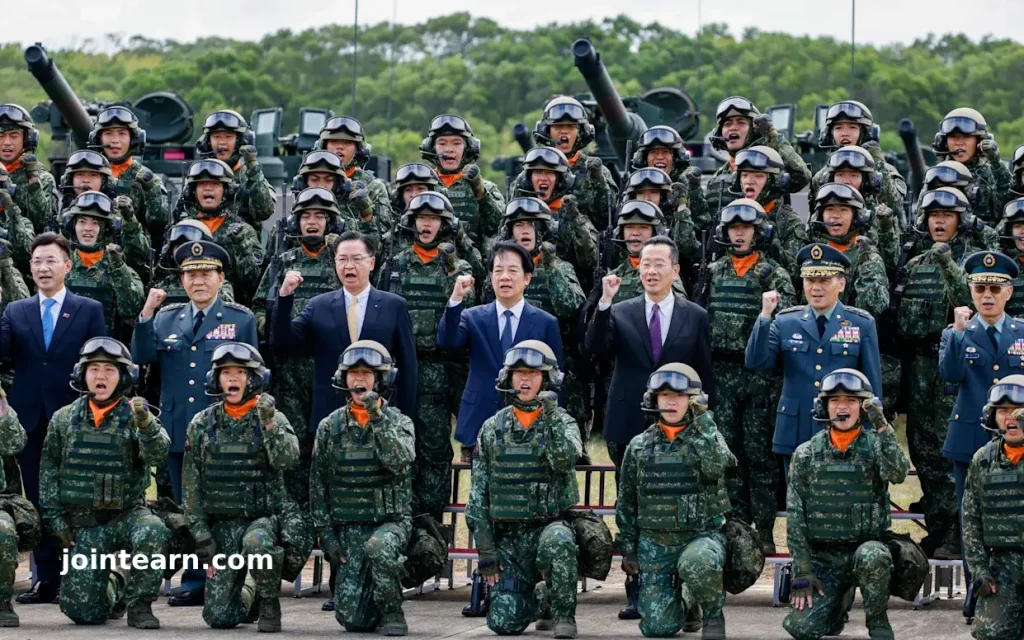
Taipei, Taiwan – Taiwanese President Lai Ching‑te announced a £30 billion (NT$1.25 trillion) supplementary defence budget on Wednesday, aimed at countering rising military threats from China. The new package focuses on enhancing Taiwan’s joint combat readiness, purchasing advanced U.S. weapons, and developing asymmetric capabilities to increase the costs and uncertainties of any potential Chinese aggression.
“There is no room for compromise on national security,” Lai said during a press conference at the Presidential Office, stressing that national sovereignty and democratic freedoms form the foundation of Taiwan’s nationhood.
The announcement follows an op-ed by President Lai in the Washington Post, where he praised former U.S. President Donald Trump for his global leadership and highlighted the importance of strong U.S.-Taiwan security cooperation. The op-ed emphasized that Taiwan’s strategic position in the Indo-Pacific makes it crucial to strengthen defence capabilities to deter aggression.
Key Goals of Taiwan’s £30 Billion Defence Package
The special budget, covering the period from 2026 to 2033, is intended to:
- Expand the T-Dome multi-layered air defence system, similar to Israel’s Iron Dome, to intercept missiles, rockets, drones, and combat aircraft.
- Purchase additional U.S.-made arms, fighter jets, and precision weapons systems.
- Enhance asymmetric warfare capabilities, improving Taiwan’s ability to inflict significant costs on any aggressor.
- Strengthen military readiness to achieve a high level of joint combat preparedness by 2027.
- Fund AI-enhanced surveillance and defense technologies to counter espionage and information warfare.
Taiwan’s defence spending is set to rise to 3.3% of GDP in 2026, crossing the 3% threshold for the first time in more than 15 years, with a target of 5% by 2030. The new £30 billion package represents an increase of £7–8 billion on previously planned allocations.
China-Taiwan Tensions and Regional Context
President Lai described China’s military buildup and repeated provocations in the Taiwan Strait, East and South China Seas, and across the Indo-Pacific as a growing threat to regional stability.
“The People’s Republic of China’s unprecedented military buildup, combined with intensifying provocations, highlights the fragility of peace in the region,” Lai wrote in his op-ed.
Taiwan is also closely monitoring regional developments involving Japan, which has expressed willingness to support Taiwan militarily in the event of a Chinese attack. Beijing has condemned these statements and accused Japan of escalating tensions.
Strategic Partnership with the United States
The U.S. remains Taiwan’s primary partner for military equipment and support. Since taking office, President Lai has highlighted U.S. assistance, including a recent $330 million arms package authorized by Trump, which included fighter jet parts and other critical military components.
The new defence budget will accelerate arms acquisitions and bolster Taiwan’s indigenous defence industry, particularly for the T-Dome air defence system, long-range missiles, and counter-drone technologies.
“This historic investment underscores our commitment to defending Taiwan’s democracy and strengthening deterrence against aggression,” Lai said.
Why This Defence Boost Matters
The £30 billion supplementary budget not only increases Taiwan’s conventional and asymmetric military capabilities, but also sends a strong signal to Beijing that Taiwan will defend its sovereignty and democratic system. By combining advanced weapons procurement with domestic development of the T-Dome system, Taiwan aims to raise the costs of aggression for China and maintain regional peace and stability in the Indo-Pacific.


Leave a Reply