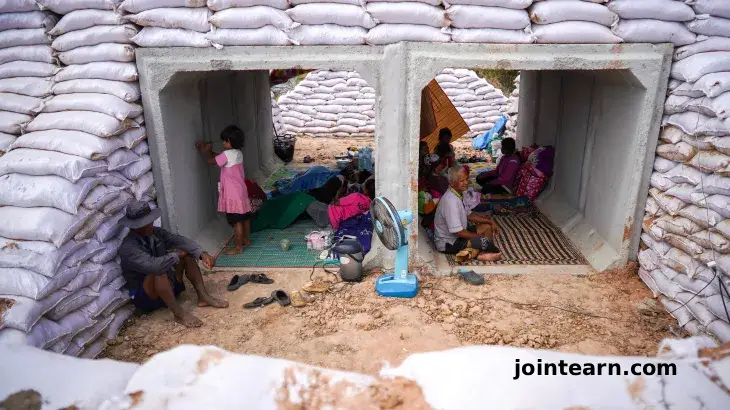
Clashes between Thailand and Cambodia have intensified, entering a third consecutive day of fighting, forcing over half a million civilians to flee their homes in a growing humanitarian crisis along the disputed border. The renewed conflict, marked by cross-border shelling, air raids, and military escalations, threatens to destabilize the region further and marks one of the deadliest confrontations between the neighboring Southeast Asian nations in recent years.
Massive Evacuations as Fighting Rages
According to Thai officials, more than 400,000 people have been relocated to safe shelters across seven provinces in Thailand. “Civilians have had to evacuate in large numbers due to what we assessed as an imminent threat to their safety,” stated Thailand’s Ministry of Defence spokesperson Surasant Kongsiri.
In Cambodia, over 100,000 people have been moved to shelters and relatives’ homes across five provinces, according to Cambodian Ministry of National Defence spokeswoman Maly Socheata. Reports indicate that conditions at evacuation centers are extremely challenging, with many displaced individuals living under makeshift tents or with minimal protection from weather conditions.
Escalating Military Tensions
The clashes began after allegations from both sides accusing each other of restarting hostilities. Thai military sources reported that rockets fired from Cambodia landed near Phanom Dong Rak Hospital in Surin province, forcing hospital staff and patients to take cover in a bunker. In response, Thai F-16 jets targeted Cambodian military positions, while Cambodian forces launched rockets and artillery fire across multiple Thai provinces.
Al Jazeera reports that the fighting has spread across almost all border provinces in both countries, with Surin province witnessing multiple exchanges of fire. Thousands of civilians on both sides have sought refuge in evacuation camps, fearing further escalation.
Political Responses and International Mediation
The conflict marks the deadliest flare-up since July 2025, when five days of fighting killed dozens and displaced around 300,000 people before a US-mediated truce. United States President Donald Trump announced he would make calls to attempt to stop the renewed fighting, highlighting the international concern over the conflict.
Despite Trump’s intervention, Thai Foreign Minister Sihasak Phuangketkeow stated that Bangkok sees little potential for negotiations, emphasizing that Thailand did not initiate the clashes. Meanwhile, Cambodia accuses Thai forces of indiscriminately targeting civilian areas with artillery shells—a claim Thailand rejects.
Human Rights Watch has warned that the use of long-range weapons by Cambodia poses significant dangers to civilians, with no assurance of safety in evacuation camps due to the inaccuracy of rocket fire.
Underlying Causes of the Conflict
The roots of the Thailand-Cambodia border dispute lie in colonial-era demarcation lines and competing claims over historical temples along the 500-mile frontier. Tensions escalated recently when Thailand suspended de-escalation measures agreed at an October 2025 summit in Kuala Lumpur, after a Thai soldier was injured by a landmine allegedly laid by Cambodia—a claim Phnom Penh denies.
The conflict has not only displaced civilians but has also affected regional cooperation, with Cambodia withdrawing from the Southeast Asian Games in Thailand due to “serious concerns” over security.
Humanitarian Impact
The ongoing hostilities have created a severe humanitarian crisis, with thousands of people living in temporary shelters with limited food, water, and medical supplies. Conditions are especially dire in Cambodia’s Oddar Meanchey province, where evacuees report insufficient aid and fear that the violence could spread further.
What Happens Next?
Experts suggest that the Thailand-Cambodia border conflict could escalate further before any lasting peace is achieved. Thai military strategy may continue to advance into Cambodian territory to secure strategic points, while Cambodia anticipates international intervention, particularly from the United States.
As of now, the situation remains highly volatile, with ongoing artillery fire, aerial attacks, and cross-border skirmishes threatening both civilian lives and regional stability.


Leave a Reply