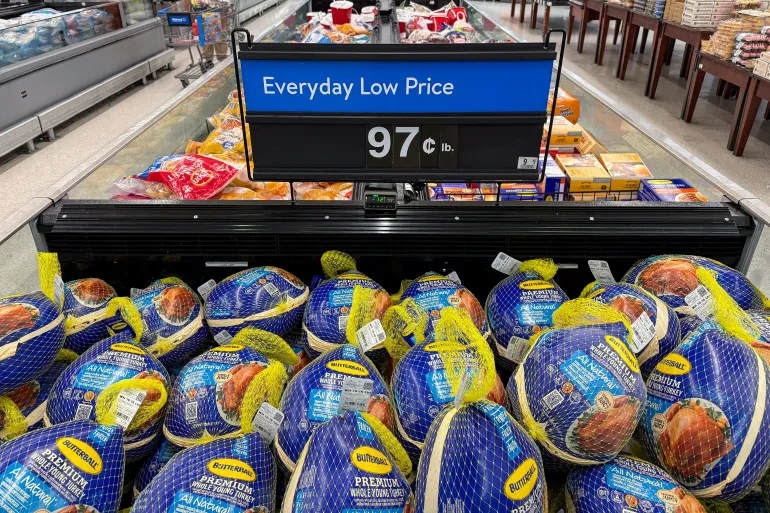
United States – November 2025 – As Americans prepare for Thanksgiving 2025, grocery prices for traditional holiday staples are on the rise, despite White House claims that inflation is under control. Key items such as turkeys, cranberries, sweet potatoes, and potatoes are seeing significant price increases, straining household budgets across the country.
Thanksgiving Meal Kits and Inflation Debate
Retailers like Walmart, Kroger, and Amazon offer Thanksgiving meal kits, which have become a flashpoint in discussions about inflation. Walmart advertised its meal kit for $4 per person for 10 people, down from $7 per person for 8 people in 2024, a change cited by the Trump administration as evidence of falling costs.
However, experts note the kit contains fewer items and more generic products, reducing its cost while masking broader price increases across the grocery sector.
“The retailer’s advertised lower price doesn’t reflect the real cost of Thanksgiving staples,” said Matthew Higgins, professor of management at Tulane University.
Turkey Prices Soar Due to Avian Flu
According to the US Department of Agriculture (USDA), turkey prices are expected to rise by 40% year-on-year, largely due to a widespread avian flu outbreak affecting over 2.2 million birds in 2025. Infected flocks must be culled to contain the disease, significantly reducing supply.
“The current H5N1 outbreak is the largest and most geographically widespread in history, affecting poultry across the United States and globally,” said Crystal Heath, executive director of veterinary advocacy group Our Honor.
Rising Prices for Other Staples
Other Thanksgiving essentials are also seeing price hikes:
- Potatoes: +3.7%
- Dinner rolls: +3.9%
- Apples: +5.3%
- Cranberry sauce: +22%
Economic policies, tariffs, and rising input costs for farming equipment and fertilizers are contributing factors. Labor shortages in agriculture have exacerbated the problem, leaving crops unharvested and driving up reliance on imports.
“When fruit hangs on the trees with no one to pick it, supply drops while demand remains high,” explained Babak Hafezi, CEO of Hafezi Capital.
Tariffs on imported materials, including steel for cans and agricultural products, have also increased costs for producers like Campbell’s, who recently raised prices on canned goods.
Consumer Strain and Economic Uncertainty
Rising grocery costs come amid broader economic uncertainty, including concerns over future SNAP benefits and potential changes to Affordable Care Act (ACA) subsidies, which could affect 2.2 million Americans.
Nonprofits such as City Harvest in New York City report record demand for food assistance, with 67% of visitors to pantries and soup kitchens employed, highlighting the impact of rising food prices on working families.
“There’s tremendous uncertainty, and as you move down the socioeconomic ladder, that uncertainty only increases,” Higgins said.
Experts note a widening gap in economic experiences: the ultra-wealthy benefit from inflation-adjusted assets, while middle- and lower-income households face rising costs and tighter budgets.
Outlook for Thanksgiving 2025
While retailers’ meal kits may offer some relief, experts warn that prices for essential items are unlikely to decrease significantly without major economic disruptions. Historical trends, such as during the COVID-19 pandemic, show that once prices rise, they often remain high due to consumer tolerance and retailer pricing strategies.


Leave a Reply