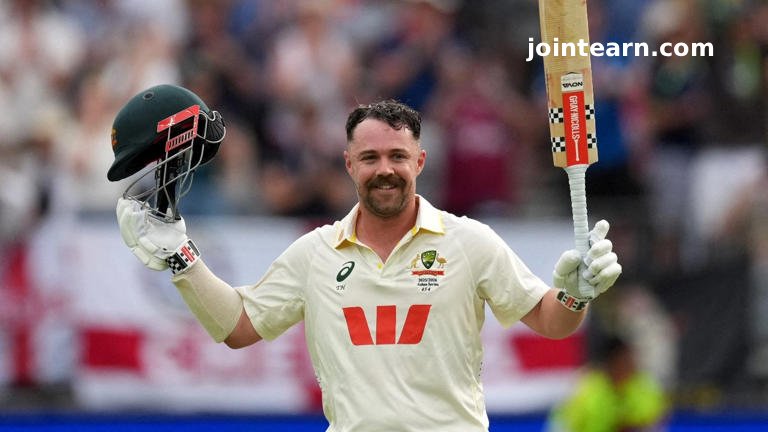
England’s Ashes campaign may have unravelled regardless, given how little they have produced to trouble Australia across the series. But while preparation, selection debates and execution failures will all be dissected, one decisive moment appears to have set the tone for everything that followed.
That moment came not in an England meeting room, but inside the Australia dressing room at tea on day two of the first Test in Perth — a simple suggestion that turned into the defining decision of the Ashes.
With Usman Khawaja ruled out by back spasms and Australia suddenly short of an opener, Travis Head raised his hand.
“It can’t be that hard. Let’s get after them.”
What followed was not just an innings, but the beginning of England’s steady dismantling.
Head’s Promotion Changes the Series Narrative
Rather than turning to experienced alternatives such as Steve Smith or Marnus Labuschagne, Australia gambled on Head, promoting him from the middle order into an unfamiliar opening role. The result was one of the great Ashes counterattacks — a blistering century that instantly shifted momentum and confidence.
That innings in Perth proved to be the first of many cuts in what became England’s death by a thousand Travis Head strokes.
By the time Head struck his second century of the series on day three of the third Test in Adelaide, the destination of the Ashes urn was effectively decided. Australia had seized total control, and Head had removed any remaining doubt over his role for the rest of the series — and likely beyond.
The solution to Australia’s long-standing search for a successor to David Warner had been there all along, sporting a mullet and unmistakable Australian swagger.
From Uncertainty to Big-Match Dominance
Before this Ashes series, Head’s form had been under scrutiny. He had managed just one score above 40 in 20 Test innings stretching back to June. Even by his own relaxed standards, he took an unusually serious approach to preparation, completing four full days of training before the series — something he later described as “unprecedented” for him.
Those sessions helped rediscover rhythm and confidence.
“When you’ve had a big gap in Test cricket, you lie there thinking, ‘Can I still do this?’” Head admitted.
“Can you still deliver in the biggest moments? It doesn’t get much bigger than this.”
Few players thrive under pressure quite like Head.
The Ultimate Big-Game Batter
Head’s Ashes performances are part of a much wider pattern. He now boasts four Ashes centuries, alongside hundreds in the 2023 World Cup final and the World Test Championship final earlier that year.
Against India last summer, when Australia desperately needed runs to reclaim the Border-Gavaskar Trophy, Head delivered scores of 89, 140 and 159 in the opening three Tests.
Former India coach Ravi Shastri once dubbed him “Head-ache” — a nickname England’s bowlers will feel painfully familiar with.
Reinvention Through Aggression
England witnessed the birth of Head’s ultra-aggressive reinvention during the 2021-22 Ashes, when he blasted 152 from just 148 balls in the opening Test. Since then, his scoring rate has surged to 80.20 runs per 100 balls, compared to 49.65 earlier in his career — a transformation almost unheard of in Test cricket.
That evolution has left England scrambling tactically.
In 2023, England deliberately bowled short — over half of deliveries from pacers pitched back of a length or shorter — targeting Head’s vulnerability to pace around the helmet. This time, opening the bowling forced England to pitch fuller, inadvertently feeding his strength square of the wicket.
Unable to hold a consistent line, England offered Head the width he thrives on.
England’s Tactical Dilemma
As the series progressed, England oscillated between attacking fields and defensive containment — neither approach proving effective. Attempts to bore Head into a mistake were particularly uncomfortable for captain Ben Stokes, whose philosophy leans heavily towards aggression.
Former Australia coach Justin Langer summed it up bluntly:
“You do not bowl to Travis Head’s cut shot. His scoring areas are completely behind point.”
Data backs that up. Head’s scoring behind square on the off side has doubled in this series compared to his previous Ashes performances.
Adelaide: Head at Home
Friday’s century at Adelaide encapsulated the issue. When England denied width, Head was quiet. When they strayed even marginally off line, he punished them. One rare error — a miscued pull narrowly clearing fine leg — only highlighted how few genuine chances England created.
He reached his hundred in near cruise control, at times strolling singles as the crowd built towards celebration.
In his home city, Head enjoys near-mythical status. Fans bowed as he raised his bat. Others wore “TravBall” shirts. On reaching three figures, he saluted the crowd before kneeling to kiss the pitch.
Statistically, his dominance at Adelaide Oval is elite. Only Ricky Ponting and Michael Clarke have scored more centuries there, while Head now averages 87.33 at the ground — placing him fourth all-time among players with five or more Tests, behind only Sir Don Bradman.
So strong is his local legacy that South Australia’s government has already floated the idea of a statue alongside Bradman’s.
The Decision England Could Not Answer
Whether this Ashes series is ultimately remembered as the summer of Travis Head, Mitchell Starc, or another Australian star will depend on what follows in Adelaide, Melbourne and Sydney. Starc’s 19 wickets already present a compelling case.
But England felt they had a genuine opportunity before Head’s Perth century — a victory there would have altered the entire trajectory of the series.
Head made that belief look naïve.
Australia may still have won regardless, but the decision to promote Travis Head was the masterstroke that England never recovered from — the move that defined the Ashes.


Leave a Reply