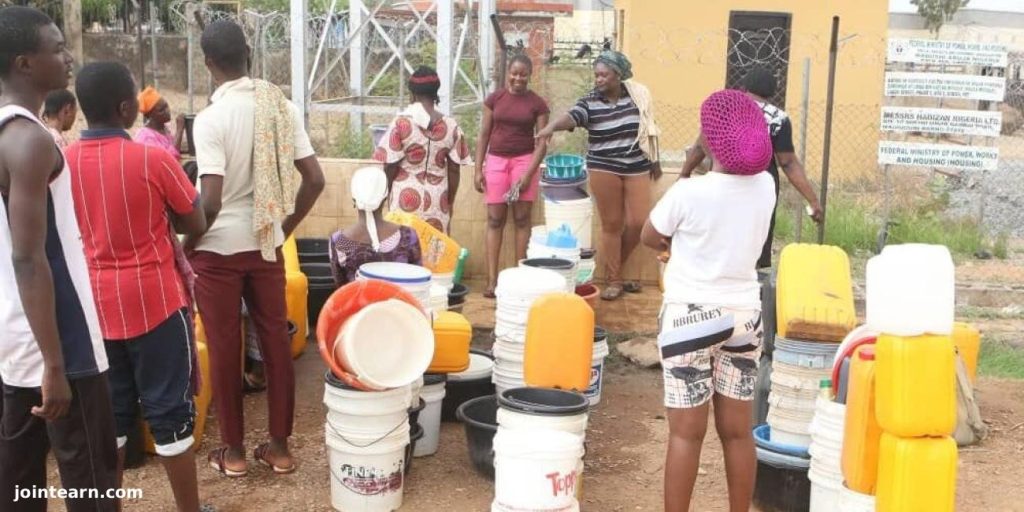
When Enugu State Governor Peter Mbah promised shortly after his 2023 inauguration that every household in Enugu metropolis would have water within 180 days, residents applauded. For a city long plagued by water scarcity, the declaration felt like a long-awaited turning point.
Nearly two and a half years later, taps across the state capital remain largely dry. Instead of relief, residents say the cost of surviving without public water has soared, pushing many households to the brink.
A Long-Standing Problem, A Deepening Crisis
Enugu’s water crisis is not new. The city’s geology—dominated by extensive coal deposits—makes groundwater extraction difficult and expensive. Surface water schemes have also struggled due to aging infrastructure, rapid population growth, and decades of underinvestment.
More than 90 percent of water pipelines in the metropolis are old asbestos pipes, prone to frequent bursts and leakages that result in massive distribution losses.
Despite these long-known challenges, residents insist the situation has worsened under the current administration.
“I bought a 500-gallon tank of water for ₦15,000 last week, and it lasted my family just three weeks,” said Ejike Stephen Udeh, a resident of Meniru in Awkunanaw. “Last year, the same quantity was between ₦8,000 and ₦10,000. The rising cost of water is frightening.”
Tanker Water Becomes a Costly Lifeline
Across Enugu, tanker-supplied water has become the primary source for homes, offices, and even hospitals—but at crushing prices.
In Uwani, Chief Eze Lazarus said the cost of a 1,000-gallon tanker has nearly tripled since Governor Mbah assumed office.
“I used to buy 1,000 gallons for ₦12,000,” he said. “Now it’s ₦35,000. And after all that, government officials still come to bill you for water you never receive. If you refuse, they send task force agents to intimidate you.”
For residents who cannot afford tanker water, sachet water—popularly known as pure water—has become the fallback. Even that option is becoming unaffordable.
In Coal Camp’s Ologo area, Miracle Ozioko said a bag of sachet water now sells for ₦350, up from ₦300.
“The government water project here hasn’t worked for over six months,” she said. “There are no head taps. We only hear announcements—nothing gets to us.”
Women, Children Bear the Burden
The burden of water scarcity falls disproportionately on women and children. In areas like Gariki, residents queue for hours at private boreholes or buy water in small quantities from vendors.
A 25-litre jerrycan now sells for ₦300, according to Ikechukwu, a resident.
“We don’t see water at all,” he said. “The governor promised water in 180 days, but even places that had water before he came have lost it. Are we progressing or regressing?”
Public health experts warn that increased reliance on unregulated water sources—streams, shallow wells, and poorly monitored boreholes—raises the risk of waterborne diseases, especially in densely populated neighbourhoods.
Promises, Sackings, and Growing Discontent
Official assurances have done little to calm public anger. In November 2023, Governor Mbah told tanker drivers to “look elsewhere for something to do,” insisting his administration would soon end water scarcity.
Two months later, in January 2024, the state government sacked 19 directors for failing to meet weekly water revenue targets—a move residents described as unjust, given that many receive no water at all.
Former Commissioner for Education and elder statesman Chief Nduka Eya has openly questioned the credibility of the administration’s claims.
“I live close to Government House and haven’t seen water in two years,” Eya said during a radio programme in Enugu. “I’m metered, but no water comes. People clapped at the 180-day promise, but no one asked questions.”
According to him, water flowed briefly before stopping due to poor planning. “They say all that’s left is connection. I submitted my house details. Till today, there’s no response. Projects are becoming conduits for stealing public funds,” he alleged.
Budget Promises vs. Reality
Budget figures appear to support residents’ frustrations. Between 2023 and 2026, Enugu State budgeted about ₦86.15 billion for water-related capital projects. However, actual fund releases tell a different story.
- 2023: ₦16.16 billion budgeted; ₦3.67 billion released (22.7%)
- 2024: ₦28 billion budgeted; ₦3.4 billion released (12.3%)
- 2025: ₦23.2 billion budgeted; ₦895.4 million released (3.8%) within nine months
Altogether, less than ₦8 billion was released for water projects between 2023 and 2025—far below 30 percent of the total budgeted amount.
“These figures show clear hypocrisy,” said Evangelist Agbo, a lecturer at Ebonyi State University. “On paper, billions are allocated. On the ground, the impact is negligible.”
Skepticism Replaces Hope
The 2026 budget again promises heavy spending—₦18.67 billion for water infrastructure, including ₦8 billion for ductile iron pipes and ₦2 billion for pipeline extensions.
But residents are no longer optimistic.
“The 180-day promise was a mirage,” said civil society activist Chimere Eze. “Tanker drivers are now celebrities. People complain, but they’re told to clap and sing praises. Hope is fading.”
As taps remain dry, Enugu’s water crisis has become more than an infrastructure failure. It is a daily symbol of broken promises, rising inequality, and the widening gap between official narratives and lived reality in the state capital.


Leave a Reply