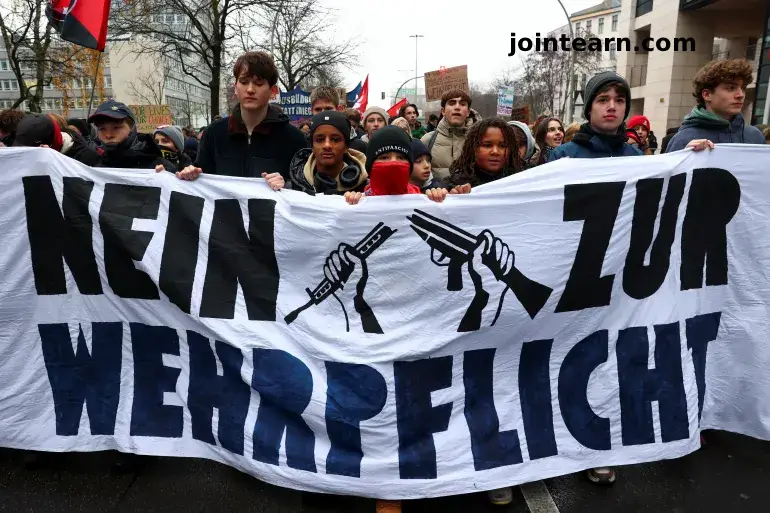
About 3,000 protesters marched through Berlin on December 5, 2025, voicing opposition to Germany’s newly approved military conscription law, which aims to strengthen the country’s armed forces amid growing security concerns in Europe.
The controversial legislation was passed by the Bundestag after months of intense debate, reflecting both domestic concerns and broader geopolitical pressures linked to Russia’s ongoing war in Ukraine.
Opposition and Public Outcry
Protesters expressed frustration over what they perceive as an unfair burden on younger generations. Tess Datzer, an 18-year-old participant, said, “There is no investment in our pensions, not in our future, not in the climate. I don’t see any good reasons why our generation should have to go to war.”
Ronja Ruh, one of the protest organizers, highlighted the allocation of funds, stating, “An unbelievable amount of money is being spent on the military and armament, while our schools are outdated, understaffed, and falling apart.”
Key Features of the New Conscription Law
The law sets ambitious targets for the Bundeswehr, Germany’s armed forces, including:
- 260,000 active soldiers by 2035 (up from 183,000 today)
- 200,000 reservists by 2035
- A dual-track recruitment system: a voluntary, more lucrative service to attract recruits, and a needs-based conscription that can be activated by Bundestag vote if enlistment falls short
All men born after January 1, 2008, will undergo medical evaluations, while both men and women will be asked to declare their willingness to serve—though only men are legally required to respond.
European Context: Reintroducing Conscription
Germany is not alone in revisiting military conscription. Several European countries, including France, Italy, Belgium, and Nordic and Baltic states, are expanding both voluntary service and mandatory military programs in response to perceived threats from Russia.
In November 2025, French President Emmanuel Macron announced a limited form of conscription, noting, “The only way to avoid danger is to prepare for it.” Germany’s top military official, Carsten Breuer, warned in 2024 that Moscow could be ready to attack NATO countries within five to eight years.
European leaders also point to a growing trend of hybrid warfare by Russia, including drone strikes, cyberattacks, and infrastructure sabotage, heightening concerns across the continent.
NATO and U.S. Influence
The conscription law aligns with broader NATO defense spending initiatives, as allies push for Europe to become more militarily self-reliant. Statements from U.S. President Donald Trump criticizing European dependence on Washington have also accelerated discussions on national defense preparedness across the EU.
Public Debate and Future Implications
The introduction of conscription in Germany has reignited debates over military spending, youth involvement in defense, and the balance between national security and social priorities. Critics argue that investments in education, healthcare, and climate initiatives are being overshadowed by military ambitions.
Proponents, however, maintain that preparing for potential Russian aggression is essential to maintain Europe’s stability and deter future attacks. The law’s implementation, particularly the activation of needs-based conscription, will likely remain a contentious topic in Germany’s political landscape.
Conclusion
Germany’s reintroduction of conscription reflects a wider European push to strengthen military capabilities amid rising tensions with Russia. The protests in Berlin underscore public resistance, highlighting the challenge of balancing national security with societal priorities.


Leave a Reply