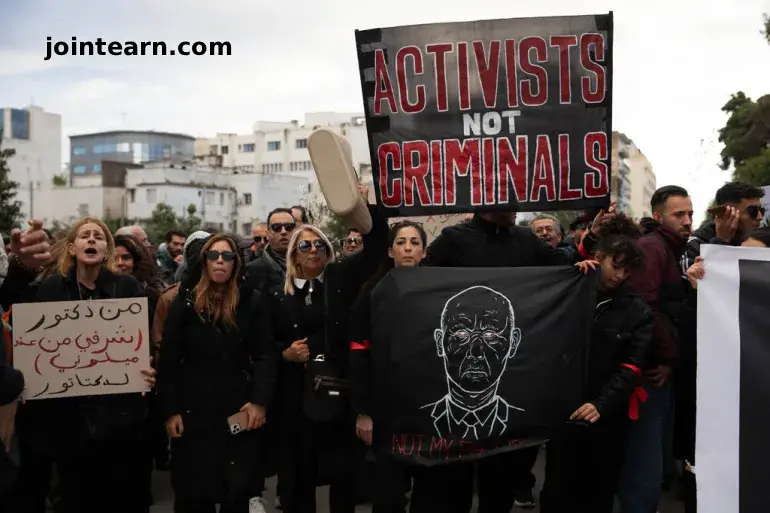
Thousands of Tunisians took to the streets of Tunis on Saturday to protest against what they describe as President Kais Saied’s escalating authoritarianism and his government’s crackdown on political opponents. The demonstrations, under the banner of “against injustice”, signal growing public frustration over arrests of critics, journalists, and activists in the North African country.
Protest Details
At least 2,000 demonstrators, dressed in black and carrying whistles and red ribbons, marched through the capital, chanting slogans such as:
- “The people want the fall of the regime”
- “No fear, no terror, the street belongs to the people”
Placards reading “Enough repression” and “Not my president” were widely displayed, highlighting a rare display of unity among opposition groups, NGOs, and civil society organizations from across Tunisia’s political spectrum.
Journalist Said Zouari told Al Jazeera that the protests demonstrate a newfound solidarity between groups with varying ideological backgrounds, though he noted that the movement has yet to elicit a response from Carthage Palace, the presidential residence.
Judicial Crackdown
The protests come weeks after a Tunisian court sentenced former administrative judge Ahmed Souab to five years in prison. Souab had been an outspoken critic of the politicization of Tunisia’s judiciary under Saied’s administration.
Critics accuse the Tunisian government of using the judiciary and police as tools to silence dissent, targeting opposition figures, journalists, lawyers, and businesspeople. Many have been detained under the pretext of “conspiring against state security.”
“All the progress of the past 14 years has been overturned,” said Ayoub Amara, one of the organizers of the protest.
“Tunisia is big enough for all Tunisians, and no single person can rule it according to his whims.”
Among those detained, some are on hunger strike, including constitutional law professor Jaouhar Ben Mbarek, who has been protesting his imprisonment for over 20 days.
Broader Political and Civil Unrest
The march is part of a broader surge in nationwide protests amid growing political and economic turmoil under Saied’s rule. Earlier in the week, journalists protested against the crackdown on press freedom and the temporary suspension of several civil society organizations.
Saied, elected in 2019 following the death of Beji Caid Essebsi, consolidated power in 2021 by suspending parliament and assuming control over all branches of government. The crackdown has particularly targeted the Ennahdha Party, part of Essebsi’s former governing coalition, with its leader Rached Ghannouchi receiving politically-motivated jail sentences.
Even former allies of the president have faced severe penalties. Nadia Akacha, Saied’s former chief of staff, was sentenced in absentia to 35 years in prison earlier this year.
Human Rights Concerns
International human rights groups have expressed alarm over the repression. Amnesty International called the situation critical, citing arbitrary arrests, asset freezes, and suspensions targeting 14 NGOs. Human Rights Watch reported over 50 individuals—including politicians, lawyers, journalists, and activists—have been arbitrarily arrested or prosecuted since late 2022.
Authorities have reportedly used antiterrorism and cybercrime laws to criminalize dissent and suppress free speech. Despite these claims, Saied denies authoritarianism, insisting his actions are meant to cleanse Tunisia of “traitors.”


Leave a Reply