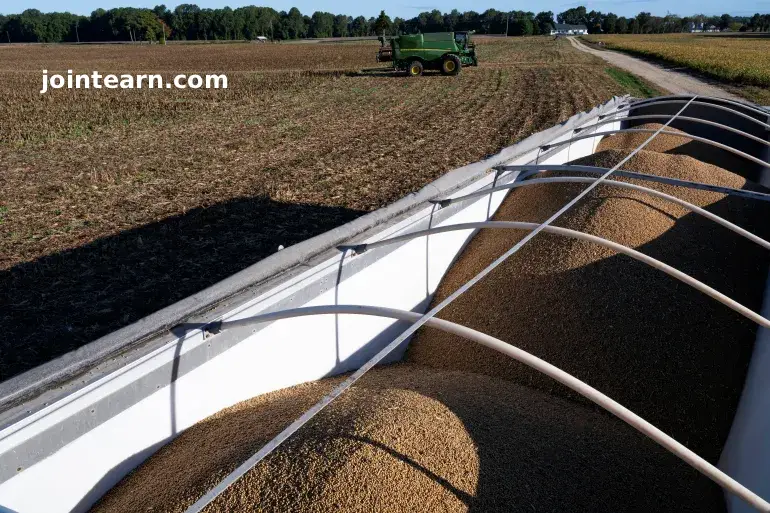
US President Donald Trump unveiled a $12 billion aid package for American farmers, aiming to offset losses caused by falling crop prices and retaliatory tariffs stemming from his trade policies. The announcement comes as farmers, particularly those producing soybeans, corn, and cotton, continue to feel the economic strain of international trade disputes.
Details of the $12 Billion Aid Package
Trump introduced the plan at the White House in Washington, DC, alongside Agriculture Secretary Brooke Rollins and local farmers. The aid program, named Farmer Bridge Assistance, allocates:
- $11 billion for row crop farmers cultivating corn, soybeans, cotton, and other staple crops.
- $1 billion for specialty crops not included in the main program.
Funds are expected to be disbursed by the end of February 2026, with applications opening in the coming weeks.
“Maximising domestic farm production is a big part of how we will make America affordable again and bring down grocery prices,” Trump said during the unveiling.
How the Aid Will Be Distributed
The US Department of Agriculture (USDA) will calculate per-acre payments using a formula designed to estimate production costs. Key details include:
- Payments capped at $155,000 per farm or individual.
- Only farms earning less than $900,000 annually are eligible.
- Focus on supporting small-scale farmers affected most by tariffs and rising input costs.
Trump emphasized that the funding will come from tariff revenues, highlighting his belief in using trade policy to support domestic agriculture.
Why the Aid Package Is Needed
US farmers, especially in the Midwest, have been significantly affected by Trump’s trade policies. Tariffs imposed on foreign goods have prompted retaliatory tariffs from China, severely impacting US exports of soybeans and other commodities.
- Historically, over 50% of US soybeans were exported to China.
- After tariffs, China raised duties on US soybeans to 34%, causing exports to fall by more than half.
- Many farmers have turned to other markets, but competition from Brazil and South America has grown.
The tariffs have also increased the cost of fertilizer, with Moroccan fertilizer tariffs rising from 2.1% to 16.8%, squeezing farm profit margins.
Trump’s Trade Policies and Their Impact
Trump defended his trade policies, claiming tariffs protect US farmers in the long run. He argued:
“It’s amazing… the smart people who understand it. Other people are starting to learn, but the smart people really understand it.”
However, critics argue that the tariffs have increased costs, reduced exports, and created uncertainty, leaving farmers reliant on government aid rather than open markets.
Other Pressures on US Agriculture
- Rising input costs for seeds, fertilizer, and machinery.
- High inflation, driving up the price of everyday staples like potatoes (+3.7%), bread rolls (+3.9%), and apples (+5.3%).
- Farm bankruptcies rose 60% in the first half of 2025 compared to the previous year.
- Total farm sector debt projected to rise to nearly $600 billion.
Family farms and smaller operations have been disproportionately affected, while larger industrial farms have absorbed more of the shock.
Will the $12 Billion Package Be Enough?
While the aid program provides immediate relief, experts and farmers caution it is a temporary solution. Many stress the need to restore access to markets and stabilize prices rather than rely on subsidies.
- Kentucky farmer Caleb Ragland told the Associated Press:
“[It’s] a start, but we need to be looking for avenues to get our markets going. That’s where we want to make a living from.”
- Democratic National Committee deputy executive director Libby Schneider said:
“Farmers don’t want handouts – they want their markets back.”
Looking Ahead
Trump’s $12 billion bailout echoes his 2018 aid program, introduced during earlier US-China trade disputes. Analysts say the program may temporarily ease financial pressures, but the long-term viability of small-scale farming remains uncertain as trade tensions and rising costs persist.


Leave a Reply