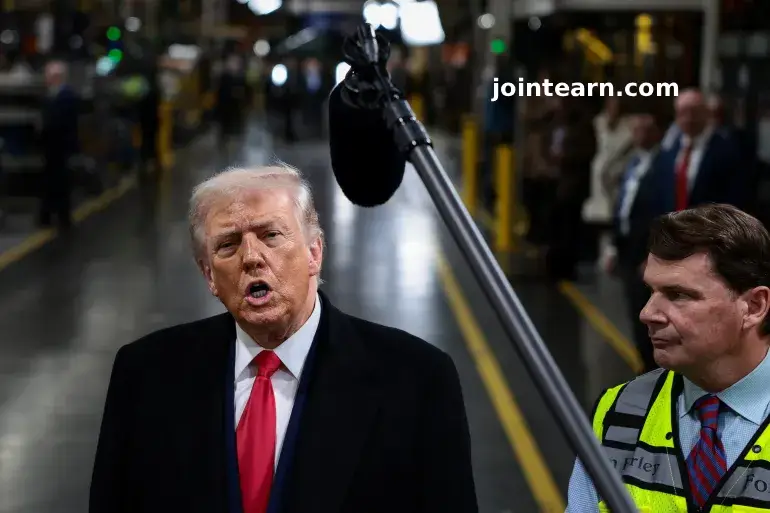
US President Donald Trump dismissed the United States-Mexico-Canada Agreement (USMCA) as “irrelevant” for the United States, while automakers emphasize its critical role in the North American auto industry.
During a visit to Detroit, Michigan, Trump argued that the USMCA no longer provides a significant advantage for American manufacturers, urging companies to bring production back to the United States.
“There’s no real advantage to it; it’s irrelevant,” Trump said about the trade agreement. “Canada would love it. Canada wants it. They need it.”
US Automakers Stress Importance of North American Supply Chains
Despite the president’s remarks, Detroit’s three major automakers—Ford, General Motors, and Stellantis—depend heavily on supply chains that span the US, Canada, and Mexico. These supply networks allow automakers to source critical parts efficiently while producing hundreds of thousands of vehicles across all three countries annually.
Industry leaders, including Tesla, Toyota, and Ford, previously urged the Trump administration to extend the USMCA, highlighting the agreement’s importance to American auto production.
The American Automotive Policy Council (AAPC), representing the Detroit Three, emphasized that the USMCA:
- Supports global competitiveness through regional integration.
- Delivers efficiency gains and cost savings.
- Contributes tens of billions of dollars annually in operational savings.
Mark Reuss, President of General Motors, stressed the complexity of these supply chains, stating, “Our supply chains go all the way through all three countries. It’s not simple. It’s very complex. The whole North American piece of that is a big strength.”
Trump Pushes for Domestic Manufacturing
During his Detroit visit and tour of a Ford factory in Dearborn, Trump reiterated his push for reshoring manufacturing.
“The problem is, we don’t need their product. You know, we don’t need cars made in Canada. We don’t need cars made in Mexico. We want to take them here. And that’s what’s happening,” he said.
This aligns with Trump’s long-standing policy goal of increasing domestic production and reducing reliance on imports from neighboring countries.
USMCA Review Looms
The USMCA, which replaced the North American Free Trade Agreement (NAFTA) in 2020, includes a clause requiring a joint review by the three member countries after six years. This review, scheduled for 2026, will determine whether the agreement should be renewed, modified, or allowed to expire.
Automakers warn that abandoning the USMCA could negatively impact production and competitiveness. Stellantis, for example, noted in November that under existing 15% tariffs with Japan, US-made vehicles that comply with North American content rules could still lose market share to Asian imports, potentially harming American automotive workers.
Market Impact
On Wall Street, the USMCA debate has influenced investor sentiment. As of the latest trading:
- Ford is down 0.25%.
- Stellantis is down 2.9%.
- General Motors is up 0.6%.
Analysts suggest that uncertainty around trade agreements like the USMCA can impact production planning and investor confidence in the auto industry.
Conclusion
While President Trump calls the USMCA “irrelevant,” the North American automotive sector sees it as vital to supply chain efficiency, global competitiveness, and job security. With the agreement up for review this year, the outcome will likely shape the future of US auto manufacturing and trade relations with Canada and Mexico.


Leave a Reply