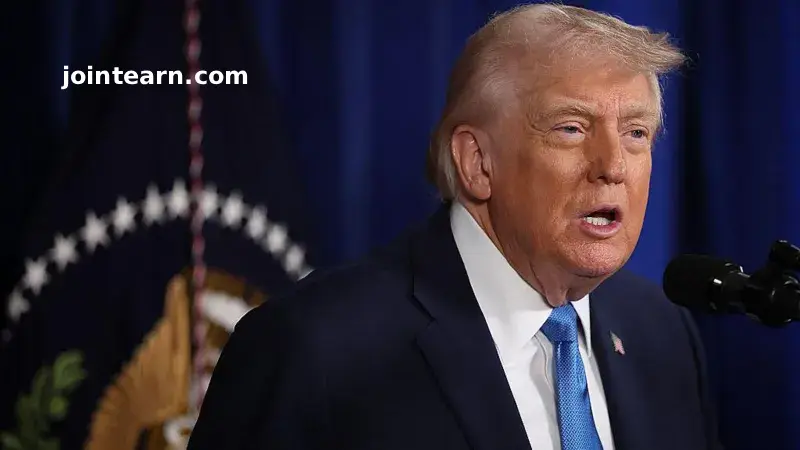
US President Donald Trump has announced that Venezuela will reportedly be turning over between 30 and 50 million barrels of oil to the United States following a military operation that removed President Nicolás Maduro from power. The transfer, valued at approximately $2.8 billion (£2.1bn) at current market prices, will reportedly be sold with the proceeds controlled directly by the US President, according to Trump’s social media posts.
Trump’s Vision for Venezuela’s Oil Industry
President Trump stated on Truth Social:
“I am pleased to announce that the Interim Authorities in Venezuela will be turning over between 30 and 50 MILLION Barrels of High Quality, Sanctioned Oil, to the United States of America. This oil will be sold at its market price, and that money will be controlled by me… to ensure it is used to benefit the people of Venezuela and the United States!”
Trump has also indicated that the US oil industry would be fully operational in Venezuela within 18 months, and expects significant American investments to rebuild the country’s oil production infrastructure.
Context: Venezuela’s Oil Reserves
Venezuela possesses the world’s largest proven oil reserves, estimated at 303 billion barrels. However, its production has been in long-term decline since the early 2000s, and the country currently has limited oil output. Analysts caution that restoring Venezuela’s oil capacity could require tens of billions of dollars and take up to a decade to return to previous levels.
Major US petroleum companies, including Chevron, ConocoPhillips, and Exxon, are reportedly reviewing the situation. Chevron confirmed it is focused on the safety and integrity of assets in Venezuela, while ConocoPhillips said it is monitoring developments and assessing implications for global energy supply. Exxon has not provided immediate comment.
Justifications and Controversies
Trump has justified the operation by claiming that Venezuela had previously “stolen” American oil, an assertion repeated by Vice-President JD Vance, who described Maduro’s government as using American assets to fund narcoterrorist activities.
However, experts note the claim is overly simplistic:
- US oil companies historically operated in Venezuela under license agreements.
- Venezuela nationalized its oil industry in 1976 and increased state control in 2007 under President Hugo Chávez.
- A World Bank tribunal in 2019 ruled that Venezuela owed $8.7 billion in compensation to ConocoPhillips for its 2007 expropriation, which remains unpaid.
BBC Verify highlighted that the oil was never legally owned by the US, meaning the term “stolen” does not fully reflect the complexities of Venezuelan law and international agreements.
Political and Economic Implications
Trump has framed Venezuela’s oil as a strategic asset for the US, arguing it would help stabilize oil prices domestically. Analysts, however, warn that large-scale production and extraction would face technical, financial, and logistical challenges, and any impact on global oil prices is unlikely to be immediate.
The situation also raises questions about US influence in Latin America, the legality of seizing state resources, and the role of American oil companies in post-Maduro Venezuela.
What Happens Next
- Maduro has been brought to the US to face drug-trafficking and weapons charges.
- Interim Venezuelan authorities are in place, and Trump has pledged to oversee the management of oil proceeds.
- US companies are expected to evaluate investment opportunities, though restoration of oil infrastructure could take years.


Leave a Reply