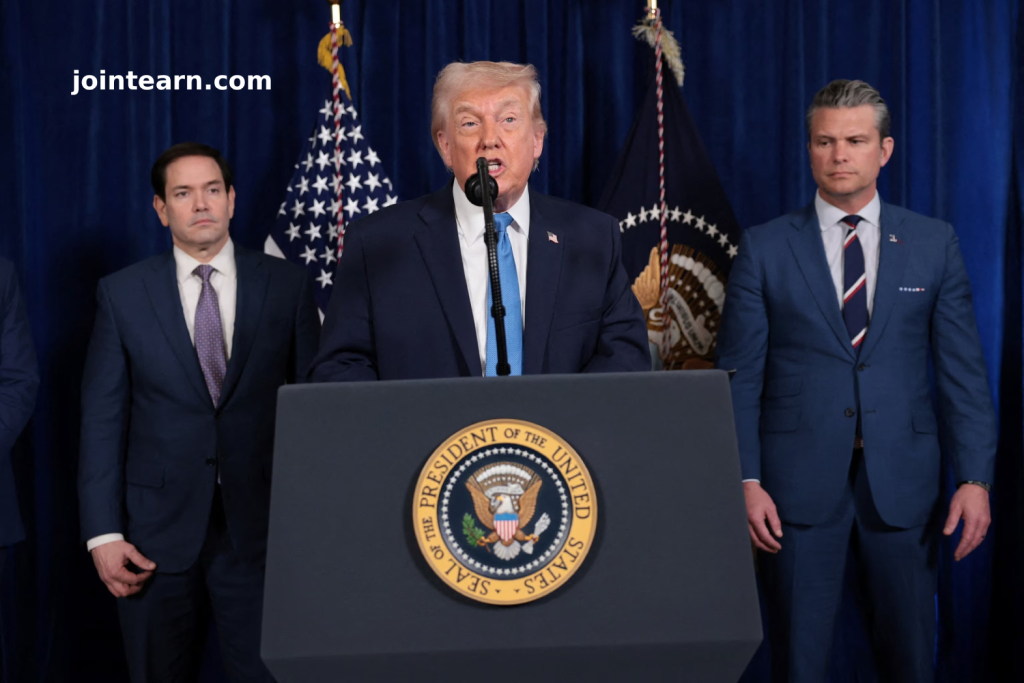
US President Donald Trump has announced that the United States will temporarily run Venezuela following the capture of President Nicolás Maduro and his wife, Cilia Flores, in a high-profile US military operation. Speaking at a news conference ahead of Maduro’s transfer to New York, Trump outlined plans to manage Venezuela’s oil resources and rebuild its “broken infrastructure” to generate revenue for the country.
US Strikes and Maduro’s Capture
The US military operation began early Saturday morning, targeting Caracas with coordinated strikes on military bases and Maduro’s safe house. Explosions were reported across the capital, while dozens of US aircraft were seen in the skies. Using elite forces, drones, and specialized equipment, US troops captured Maduro and Flores and removed them from the country.
Afterward, the pair were transported by US helicopter to the USS Iwo Jima in the Caribbean, then to Guantanamo Bay, and finally flown to New York City, where they were placed in the Metropolitan Detention Center in Brooklyn.
US Attorney General Pam Bondi announced that Maduro and Flores face charges in the Southern District of New York, including:
- Conspiracy to commit narco-terrorism
- Importation of cocaine
- Possession of machine guns and destructive devices
- Conspiracy to possess machine guns and destructive devices
Bondi stated on X that the couple will “soon face the full wrath of American justice on American soil in American courts.”
Trump’s Plan for Venezuela
Trump described Venezuela’s oil industry as a “total bust” and outlined plans for US oil companies to invest billions of dollars to repair infrastructure and generate income for the country. Venezuela holds roughly 303 billion barrels of crude oil, representing about 20% of the world’s known reserves, according to the US Energy Information Administration.
While the exact details of US administration of Venezuela remain unclear, Trump said a “group” of US officials would oversee operations, with Secretary of State Marco Rubio reportedly engaging with Delcy Rodríguez, Venezuela’s vice president, to coordinate activities. Rodríguez has since been sworn in as interim president by Venezuela’s Supreme Court, though she reaffirmed Maduro as the “only president” in official statements.
Trump also stated he had not spoken to opposition leader María Corina Machado, barred from the 2024 election, noting she lacked the support to govern the country.
International Reaction
The US operation has sparked intense global debate:
- Russia condemned the operation as “an act of armed aggression.”
- China called the strikes “deeply shocking” and strongly criticized US actions.
- Cuba described the move as a “criminal attack.”
- Argentina’s Javier Milei, an ally of Trump, welcomed the action on social media.
Many Latin American countries, including Colombia, Brazil, and Chile, expressed concern over sovereignty violations, while US allies like the UK, EU, France, and Germany urged a peaceful transition and respect for the will of the Venezuelan people. UN Secretary-General António Guterres also warned that the operation sets a “dangerous precedent” and questioned compliance with international law.
US Counter-Narcotics Justification
The Trump administration has framed the military strikes as part of a long-term campaign against drug trafficking, claiming the operation targeted Venezuelan ports used for cocaine and fentanyl smuggling. More than 30 strikes have reportedly occurred in the past months against alleged drug operations in the Caribbean and Pacific, resulting in over 100 casualties, according to US reports.
However, experts in counter-narcotics note that Venezuela is primarily a transit country for drugs produced elsewhere and plays a relatively minor role in the global narcotics trade. Critics argue that the US may be using anti-drug operations as a pretext to seize control of oil resources and political power.
Geopolitical Implications
Trump’s move to temporarily run Venezuela represents a high-risk intervention with far-reaching consequences. Analysts warn that while it may allow the US to control a major portion of the world’s oil reserves, it could destabilize Latin America, strain US relations with global powers like Russia and China, and set a precedent for unilateral military interventions.
The operation has already prompted discussions about US influence in the Western Hemisphere, international law compliance, and potential conflicts with other regional governments.


Leave a Reply