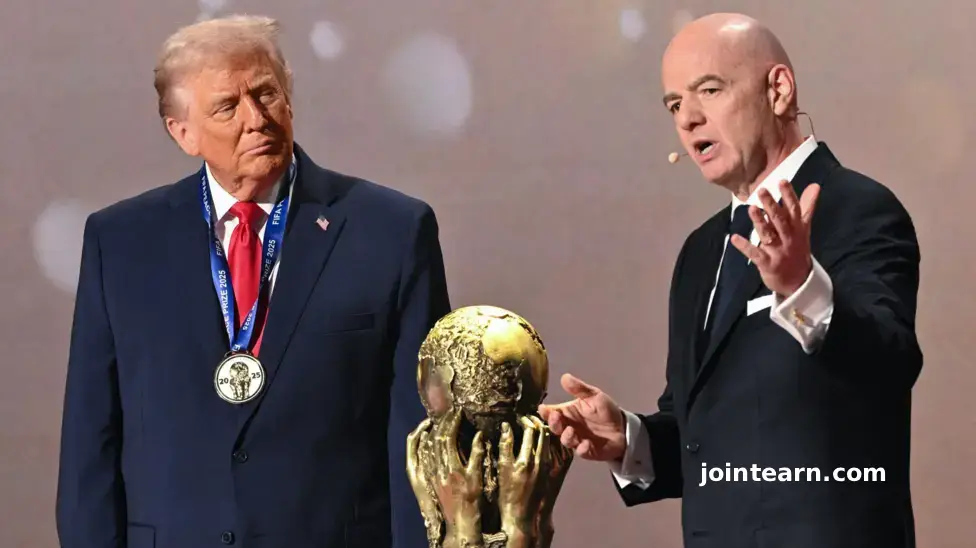
US President Donald Trump’s recent international actions — including the capture of Venezuelan President Nicolás Maduro and threats of military operations in Greenland, Mexico, Colombia, and Cuba — have sparked concern about whether the United States’ hosting of major sporting events aligns with principles of international law and sports neutrality.
MPs Raise Concerns
A cross-party group of 23 UK MPs has urged FIFA and other international sporting bodies to consider expelling the US from the World Cup unless it demonstrates compliance with international law. Their argument is that sporting events should not legitimize or normalize violations of sovereignty.
The MPs highlighted:
- The seizure of Venezuelan leader Nicolás Maduro.
- Threats toward multiple other countries, including NATO members and World Cup participants.
- Comparisons to FIFA’s prior bans on Russia following the Ukraine invasion.
FIFA and the IOC’s Position
- FIFA: President Gianni Infantino awarded Trump the inaugural FIFA Peace Prize in December 2025 and maintains close ties with the US administration. FIFA has declined to comment on the MPs’ motion and is unlikely to sanction the host nation, prioritizing tournament delivery over political considerations.
- IOC: The International Olympic Committee similarly does not plan to exclude American athletes from the 2026 Winter Olympics in Milan-Cortina. The IOC maintains that political conflicts fall outside its remit, emphasizing global participation and neutrality.
Past decisions provide context:
- 2018 World Cup went ahead in Russia despite geopolitical controversy.
- 2022 Russia sanctions focused on safety and participation restrictions rather than FIFA taking a moral stance.
- The IOC also upheld Israel’s participation amid accusations of human rights violations, citing compliance with the Olympic Charter.
Potential Complications for the World Cup
Experts warn of a “stress-test” for sporting institutions:
- Geopolitical tensions: If Trump’s administration escalates military actions — for example, in Greenland — questions could arise about Denmark’s participation and European or NATO leaders’ attendance.
- Travel and visa restrictions: Fans from countries like Iran, Haiti, Senegal, and Ivory Coast may face partial or full travel bans, complicating attendance.
- Domestic unrest: Rising domestic tensions and protests in the US may impact security planning, fan experience, and the perception of the tournament as “welcoming and unifying.”
- Human rights concerns: Organizations warn of the World Cup being “weaponized for authoritarian aims,” citing attacks on immigrants, press freedoms, and protesters.
FIFA and US authorities have introduced measures to mitigate travel and visa issues, but the intersection of geopolitics and global sport is unavoidable.
Conclusion
While the US is set to host both the 2026 World Cup and upcoming Olympics, Trump’s foreign policy presents unique challenges for international sports bodies. FIFA and the IOC must balance neutrality, safety, and global participation against the backdrop of potential conflicts, human rights concerns, and international scrutiny.
As the tournament approaches on 11 June 2026, the 48-team World Cup may serve as a litmus test for whether global sports can truly remain apolitical in an era of heightened geopolitical tension.


Leave a Reply