Kampala, Uganda – January 15, 2026 – Polls have officially closed across Uganda after a tense and chaotic day of voting in the 2026 general elections, with President Yoweri Museveni seeking to extend his remarkable four-decade rule. The election day was marked by delays, technical glitches, and an unprecedented internet blackout, raising concerns about transparency and fairness.
Results from the presidential and parliamentary elections are expected within 48 hours, with the country holding its breath as political tensions remain high.
Voting Challenges and Delays
Across Uganda, many polling stations experienced delays of several hours due to logistical challenges. Ballot boxes arrived late, and biometric verification machines—used to confirm voters’ identities—malfunctioned in several locations. Many Ugandans and election observers attributed these problems to the ongoing internet blackout, which has disrupted communication nationwide.
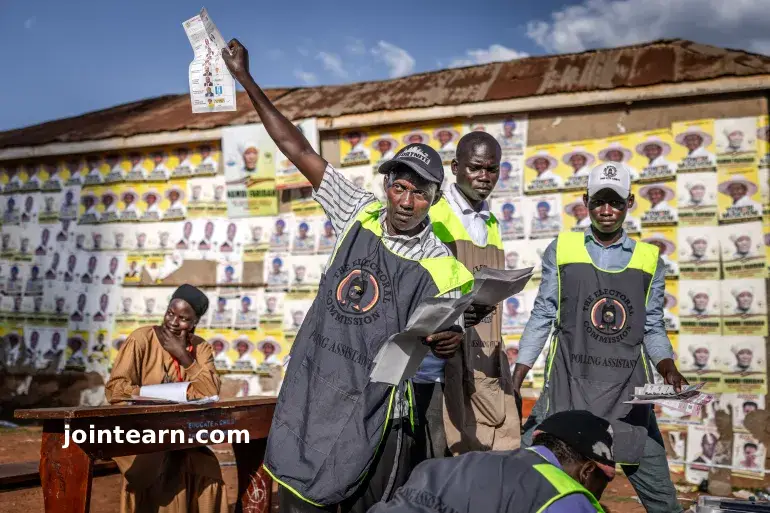
A polling assistant from Uganda’s Electoral Commission was seen counting votes at a public ground in Kampala after the polls closed, highlighting the country’s attempt to proceed with elections under challenging circumstances.
Opposition Criticism and Allegations of Rigging
President Museveni’s main challenger, Bobi Wine, a singer-turned-politician, criticized the election process immediately after casting his vote. “We are holding elections in the dark,” Wine said, accusing the government of facilitating potential electoral rigging. He urged Ugandans to remain vigilant and resist any manipulation of the vote.
Despite fears of unrest, no significant protests were reported as polling stations began closing after 5 pm local time (14:00 GMT), and counting of ballots commenced.
Museveni’s Stronghold and Election Confidence
President Museveni, who has been in power since 1986, expressed confidence in his expected victory. Speaking to reporters in western Uganda, he predicted securing up to 80% of the vote “if there’s no cheating,” dismissing any chance of an upset by Bobi Wine.
Museveni’s long tenure has been controversial: while many credit him with stabilizing Uganda after post-independence turmoil and driving economic growth, his government has faced allegations of corruption and repression of political opposition.
Internet Blackout Sparks International Criticism
Days before the election, the Ugandan government instructed mobile network operators to suspend public internet access, citing concerns over misinformation and potential voter fraud.
Human rights groups and international organizations condemned the move. Amnesty International labeled it “a brazen attack on the right to freedom of expression,” while the UN Human Rights Office warned that Ugandans were heading to the polls amid “widespread repression and intimidation” of political opposition, journalists, and human rights defenders.
Key Issues for Ugandan Voters
With over 21.6 million registered voters, many Ugandans, particularly first-time voters, cited unemployment and economic opportunity as major concerns. About 70% of Uganda’s population is under 35, making youth issues central to this election.
Ronald Tenywa, a 45-year-old university researcher in Kasangati, north of Kampala, said, “Political leaders cling on for a long time. If we vote for someone who truly cares, things will improve for Uganda.”
However, many voters continue to support Museveni, praising him for maintaining peace, security, and organization across the country. Angee Abraham Lincoln, a Museveni supporter, said, “The country is stable, and the party is well-organized,” reflecting a segment of the population that values continuity.
Security and Election Precautions
The government deployed heavy police and army presence throughout the election day to deter anti-government protests. Local media, including the Daily Monitor, ran guides on how citizens could “election-proof” their homes, advising measures like reinforcing doors, windows, and designating safe rooms in case of unrest.
Alongside Museveni and Wine, six other opposition candidates contested the presidency, while voters also selected members of parliament. Observers are closely monitoring the process for signs of irregularities.
What’s Next
With ballot counting underway, the world awaits the official results. The 2026 Ugandan general election will not only determine whether Museveni continues his decades-long rule but also signal the state of democracy, civil liberties, and youth engagement in one of East Africa’s most politically complex nations.
The international community and local watchdogs continue to call for transparency, accountability, and respect for human rights, highlighting that Uganda’s political future hinges on the credibility of this election.


Leave a Reply