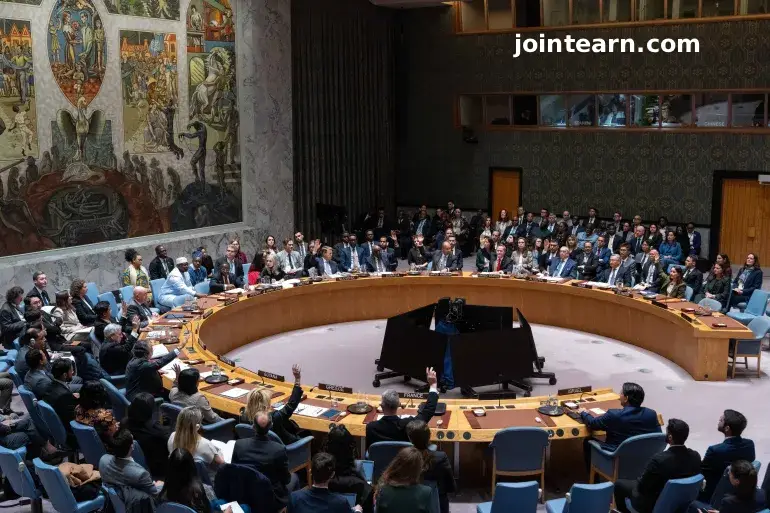
The United Nations Security Council (UNSC) has approved a landmark resolution supporting a comprehensive Gaza peace plan, marking a potential turning point in the two-year conflict between Israel and Hamas. The resolution authorizes a transitional administration and the deployment of an international stabilization force (ISF) in Gaza, while envisioning a “credible pathway” toward the establishment of a Palestinian state.
UN Security Council Vote and Key Provisions
The resolution passed with 13 votes in favor, with no vetoes. Russia and China abstained, citing concerns that the plan lacks meaningful Palestinian participation and remains ambiguous regarding governance structures.
The approved plan includes:
- The formation of an international stabilization force to collaborate with Israel, Egypt, and newly trained Palestinian police to secure border areas and work toward demilitarization.
- Establishment of a Board of Peace, a transitional governing body for Gaza with a mandate extending until the end of 2027. Former US President Donald Trump is theoretically designated to chair this board.
- References to a future Palestinian state, though details remain vague and subject to further negotiations.
Reactions from Palestinian Factions
Hamas, which currently governs Gaza but was excluded from the transitional administration, rejected the resolution. In an official statement, the group called the plan “an international guardianship mechanism” and criticized the ISF’s mandate to disarm resistance groups, arguing that it compromises the neutrality of the force.
The Palestinian Authority (PA) welcomed the resolution, emphasizing the plan affirms Palestinians’ right to self-determination and the creation of an independent state. The PA stressed the need to implement the plan on the ground immediately, ensuring humanitarian aid flows unimpeded, normal life returns, and reconstruction efforts begin.
Israel’s Endorsement
Israeli Prime Minister Benjamin Netanyahu’s office praised the UNSC resolution, claiming it would promote peace and prosperity by enforcing the full demilitarization and disarmament of Gaza. The office highlighted that the plan aligns with the Abraham Accords framework and could facilitate regional integration and the return of deceased hostages.
International Perspectives
- China abstained from the vote, with UN Envoy Fu Cong stating the plan is “vague on many crucial issues,” particularly regarding Palestinian governance and the scope of the multinational force.
- Russia also abstained, asserting the resolution sidelines Palestinian input and risks entrenching the division between Gaza and the West Bank. Russian Ambassador Vassily Nebenzia warned against the plan becoming a “fig leaf” for US-led experiments in the region.
- France supported the resolution to facilitate humanitarian aid delivery, disarm Hamas, and bolster ongoing peace efforts.
- The United Kingdom backed the plan, emphasizing the urgent need to open crossings, enable aid delivery, and advance a two-state solution.
- Indonesia welcomed the resolution, underscoring the importance of Palestinian involvement in the peace process and indicating readiness to deploy up to 20,000 personnel for peacekeeping.
- Donald Trump hailed the UNSC approval as a historic breakthrough and a significant achievement for global peace, though he did not explicitly mention Israel, Hamas, or Palestinians.
Outlook and Challenges
While the UNSC resolution represents a major step forward in formalizing an international stabilization framework in Gaza, significant challenges remain. The plan’s exclusion of Hamas from governance, unclear pathways to Palestinian statehood, and ongoing humanitarian needs could complicate implementation. The international community continues to monitor the situation closely, emphasizing the need for peacekeeping, aid access, and long-term conflict resolution.


Leave a Reply