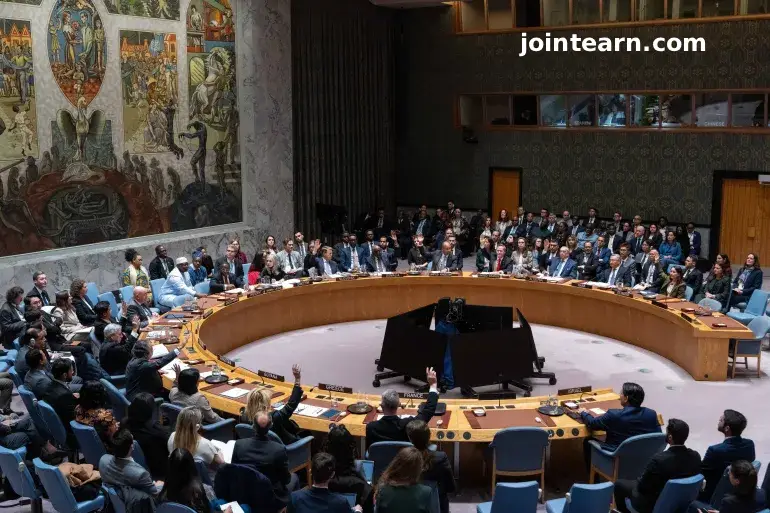
The United Nations Security Council (UNSC) has passed a resolution endorsing the deployment of an International Stabilization Force in Gaza and establishing a transitional administration that envisions a “credible pathway” toward Palestinian statehood. The resolution, proposed by the United States as part of President Donald Trump’s 20-point Middle East peace plan, was approved in a 13-0 vote on Monday, with Russia and China abstaining.
The measure aims to support a fragile ceasefire between Israel and Hamas, while setting conditions for Palestinian governance reforms and the redevelopment of Gaza.
Key Provisions of the Resolution
The resolution authorizes international troops to:
- Secure border areas and support a trained Palestinian police force.
- Coordinate with neighboring countries, including Egypt and Israel, to ensure the safe flow of humanitarian aid into Gaza.
- Oversee the demilitarization of Gaza and the permanent decommissioning of weapons from non-state armed groups.
- Use all necessary measures to carry out the mandate effectively.
The resolution also outlines a timeline and standards for the gradual withdrawal of Israeli forces, with milestones agreed upon by the stabilization force, Israel, the US, and ceasefire guarantors.
International Reactions
Israel strongly opposed the resolution, with Prime Minister Benjamin Netanyahu reiterating that the country remains against a Palestinian state and pledging to demilitarize Gaza “the easy way or the hard way.” Israeli National Security Minister Itamar Ben-Gvir escalated tensions further by calling for the assassination of Palestinian Authority officials if the UN proceeds with Palestinian state recognition.
Hamas rejected the resolution, arguing that international forces tasked with disarming resistance factions would compromise their neutrality and effectively side with the occupation.
Conversely, countries such as Qatar, Egypt, UAE, Saudi Arabia, Indonesia, Turkiye, and Jordan supported the resolution, with Algeria’s ambassador praising Trump’s personal engagement in sustaining the Gaza ceasefire.
Pathway to Palestinian Statehood
The resolution includes language signaling that conditions may be in place for a credible pathway to Palestinian self-determination and statehood, contingent upon reforms by the Palestinian Authority and progress in Gaza reconstruction. Arab and Muslim countries contributing troops emphasized that a UN mandate was essential for their participation, which influenced the inclusion of clear references to Palestinian self-governance.
US Ambassador to the UN Mike Waltz described the resolution as a step toward prosperity in Gaza while maintaining Israeli security.
Russia had circulated a competing draft resolution advocating a contiguous Palestinian state covering the West Bank and Gaza, emphasizing the Security Council’s role in maintaining peace and implementing the ceasefire. Analysts note that the adoption of the US resolution reflects regional power imbalances, with influence heavily tilted toward Israel and the United States.
Humanitarian Context
Despite the ceasefire taking effect on October 10, 2025, Israel has continued to conduct attacks in Gaza and impose restrictions on humanitarian aid. Rights groups report that more than 69,000 Palestinians have been killed, with the conflict described by observers as a humanitarian catastrophe, if not genocide.
The UNSC resolution represents an attempt to stabilize the territory while opening a potential avenue for Palestinian statehood, though opposition from Israel, Hamas, and other factions highlights the ongoing challenges in achieving lasting peace in the region.


Leave a Reply