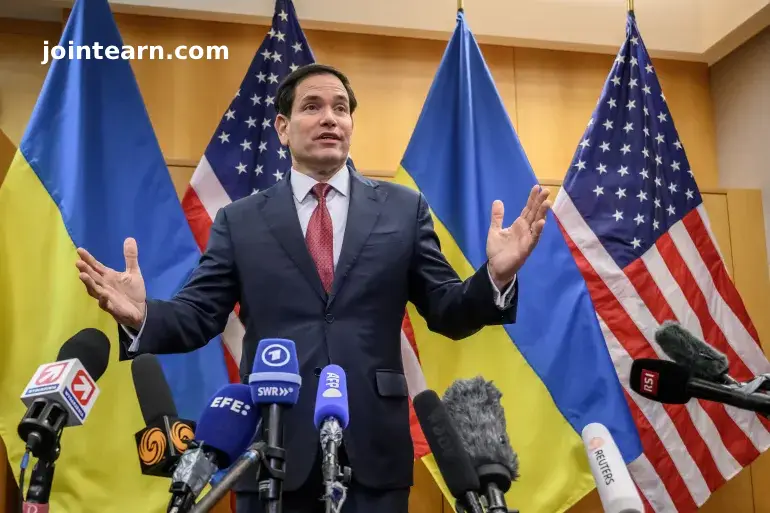
The United States and Ukraine have unveiled a revised framework aimed at ending the ongoing Russia-Ukraine war, following criticism of an earlier US proposal that was perceived as being too favorable to Moscow. The updated plan seeks to fully respect Ukraine’s sovereignty while outlining steps toward a “sustainable and just peace.”
Geneva Talks Highlight Progress
Officials from Washington and Kyiv met in Geneva for high-level discussions, describing the consultations as “highly productive” and signaling tremendous progress in aligning positions and identifying actionable next steps.
In a joint statement, both sides emphasized their commitment to ensuring Ukraine’s security, stability, and reconstruction, while working toward a peace settlement that fully upholds the country’s sovereignty.
US Secretary of State Marco Rubio said the talks included amendments to President Donald Trump’s 28-point peace plan, particularly regarding NATO’s role, to narrow differences between Kyiv and Moscow. Rubio expressed cautious optimism about reaching an agreement, noting that remaining disagreements are not insurmountable.
“I honestly believe we’ll get there,” Rubio told reporters at the US mission in Geneva.
Trump’s Peace Plan Under Scrutiny
Trump’s blueprint for ending the war has sparked controversy in Ukraine and Europe, as it aligns with some Russian demands, including limitations on Ukraine’s military capabilities and the potential relinquishment of territories such as Crimea, Luhansk, and Donetsk.
Ukrainian President Volodymyr Zelenskyy acknowledged the US’s support in defending against Russia but warned that the plan forced Ukraine into a difficult choice: “losing dignity or losing a key partner.”
Former President Trump, meanwhile, criticized Kyiv on social media for allegedly showing insufficient gratitude for US assistance, claiming that European nations continue to purchase Russian oil despite the war.
European and International Perspectives
European Commission President Ursula von der Leyen emphasized that any peace deal must respect Ukraine’s right to determine its own future, including its potential integration into the European Union.
“It starts with the country’s reconstruction, its integration into our Single Market and our defence industrial base, and ultimately, joining our Union,” von der Leyen said.
Rubio confirmed that the peace plan is a “living, breathing document” that will continue to evolve, and that Moscow’s approval would be required for implementation. Russian President Vladimir Putin indicated that the plan could form the basis of a final settlement but warned that Russia might advance further into Ukrainian territory if negotiations fail.
Key Elements of the Updated Framework
While details remain limited, the revised US-Ukraine framework reportedly focuses on:
- Upholding Ukraine’s sovereignty and territorial integrity
- Ensuring security guarantees for Ukraine
- Promoting post-war reconstruction and stability
- Adjusting the role of NATO to address concerns of all parties
- Aligning elements of the peace plan to make it acceptable to both Kyiv and Moscow
The framework aims to resolve the war without undermining Ukraine’s self-determination or forcing concessions that could compromise its independence.
Outlook: Can Peace Be Achieved?
Negotiators have acknowledged that the remaining differences between Ukraine and Russia are significant but not impossible to bridge. Both Washington and Kyiv have expressed a desire to finalize an agreement quickly, with Trump previously suggesting a Thursday deadline.
Despite lingering uncertainties, officials describe the talks as a meaningful step toward ending one of the deadliest conflicts in Europe in recent decades, providing a foundation for eventual peace and long-term reconstruction in Ukraine.


Leave a Reply