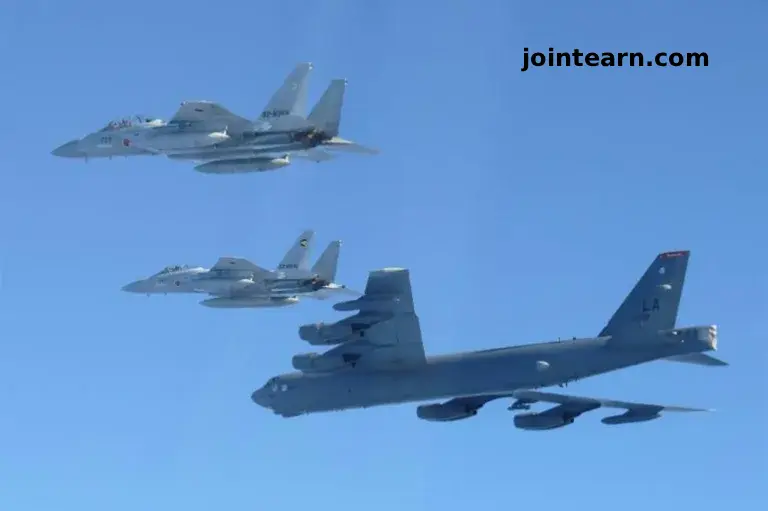
Japan and the United States held a joint air exercise over the Sea of Japan on Wednesday, demonstrating their military readiness amid escalating tensions following Chinese-Russian patrols in the region and weeks of diplomatic friction between Tokyo and Beijing.
According to the Japanese Joint Chiefs of Staff, the exercise took place in response to an “increasingly severe security environment surrounding our country.” The drills involved two U.S. B-52 strategic bombers, along with three Japanese F-35s and three F-15 fighter jets, performing coordinated tactical maneuvers to strengthen the U.S.-Japan defense alliance.
Rising Tensions with China and Russia
The exercise came after Tokyo reported that two Russian Tu-95 nuclear-capable bombers flew from the Sea of Japan to meet with two Chinese H-6 bombers in the East China Sea. The combined flight then circled Japanese territory, prompting Japan to scramble fighter jets in response.
Earlier incidents have also intensified concerns: Japan claimed that Chinese J-15 jets from the Liaoning aircraft carrier locked radar onto Japanese planes in international waters near Okinawa. In response, the U.S. State Department criticized Beijing, stating, “China’s actions are not conducive to regional peace and stability,” while reaffirming that the U.S.-Japan alliance remains stronger and more united than ever.
Political Context
Japanese Prime Minister Sanae Takaichi has previously suggested that Japan could intervene militarily if China attacked Taiwan, angering Beijing. The two countries have since engaged in diplomatic exchanges, including Japan summoning China’s ambassador over recent radar incidents.
China, through spokesperson Guo Jiakun, accused Japan of intruding into Chinese training areas and conducting reconnaissance, describing Japan’s actions as “maliciously hyping up the situation.”
Regional Security Implications
The joint exercise signals a show of force by Japan and the U.S. to deter unilateral changes to the status quo in the region. Japanese defense authorities stressed that the drills confirmed the readiness of Japanese Self-Defense Forces and the U.S. military to respond to potential threats.
South Korea also reported that Russian and Chinese aircraft entered its air defense identification zone, prompting Seoul to deploy fighter jets. NATO Secretary General Mark Rutte described the radar incident and joint patrols as “regrettable,” emphasizing that security in the Indo-Pacific and Euro-Atlantic regions is completely interconnected.
Meanwhile, Beijing and Moscow have defended their actions as routine military exercises, organized under annual cooperation plans, with Moscow noting that some foreign jets followed the joint patrol.
Key Takeaways:
- US and Japan strengthened military coordination with joint B-52, F-35, and F-15 exercises.
- Exercises were prompted by China-Russia patrols and rising regional tensions.
- Radar incidents involving Chinese J-15s near Okinawa highlighted risks of military escalation.
- Japan, the U.S., and South Korea are actively monitoring Indo-Pacific security threats.
- Diplomatic tensions persist alongside ongoing military readiness drills.


Leave a Reply