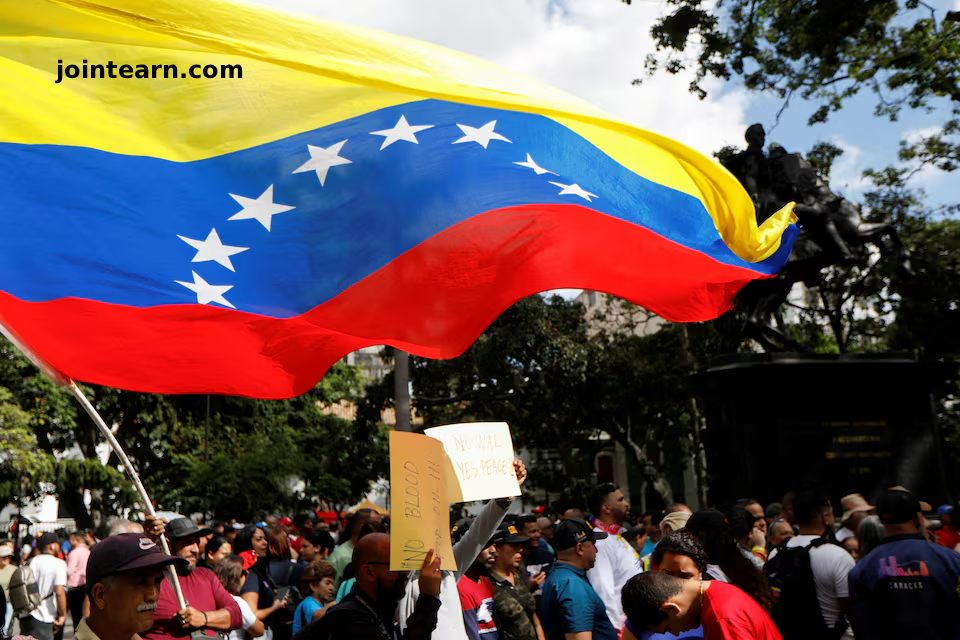
Venezuelan oil exports have slowed sharply as the United States escalates its actions against vessels carrying crude from the South American nation. Tracking data and sources indicate that many tankers are now moving only between domestic ports, while several approaching ships have suspended navigation or turned back following U.S. maritime interceptions.
U.S. Interventions and Sanctions
Earlier this month, the U.S. Coast Guard seized a supertanker under sanctions carrying Venezuelan oil. Over the past weekend, two additional Venezuela-related ships faced attempted interception:
- One empty vessel under U.S. sanctions
- One fully loaded tanker bound for China
President Donald Trump has also announced a blockade of all sanctioned oil tankers entering or leaving Venezuela, a move that has kept shipowners wary of exporting Venezuelan crude.
“Washington may either keep or sell the oil seized off Venezuela’s coast,” Trump said, adding that the U.S. would retain the seized ships.
International Reactions
- China condemned U.S. interceptions as a violation of international law.
- Venezuela called the seizures acts of piracy.
- Panama noted that the supertanker Centuries, flying its flag, had altered its name and disabled its transponder, breaching maritime regulations.
Impact on PDVSA and Oil Shipments
State-run PDVSA continues to struggle after a recent cyberattack, which has disrupted centralized administrative systems and delayed employee salaries.
- Only a single cargo of 1.9 million barrels of heavy crude was delivered to the sanctioned vessel Azure Voyager at the Jose port.
- No other supertankers were scheduled for Asian-bound exports immediately.
- Some approaching tankers for exports or imports, including naphtha deliveries, suspended navigation or turned back pending instructions.
These disruptions have left millions of barrels of Venezuelan oil stuck in ports and ships, prompting customers to demand deeper discounts or contract adjustments to mitigate risks.
Oil Prices React
The heightened geopolitical tension and risks to Venezuelan exports pushed oil prices higher:
- Brent crude: up 2.4% to $61.94/barrel
- U.S. WTI crude: up 2.4% to $57.89/barrel
The market remains concerned about supply disruptions from Venezuela and ongoing conflict in Ukraine.
Chevron and Joint-Venture Exports
PDVSA’s main partner, Chevron (CVX.N), exported 500,000 barrels of Venezuelan crude to the U.S. Gulf Coast on Sunday under U.S. authorization. Chevron has shipped seven such cargoes this month, each ranging from 300,000 to 500,000 barrels.
Oil Minister Delcy Rodriguez confirmed that deliveries to Chevron have not been interrupted.
Ongoing Maritime Risks
- The empty tanker Bella 1, which the U.S. attempted to intercept, was drifting northeast of Bermuda.
- The seized tanker Skipper reached the Galveston, Texas area for cargo transfer.
- Collectively, Skipper, Centuries, and Bella 1 have exported 41 million barrels of crude and fuel oil from Iran and Venezuela in recent years.


Leave a Reply