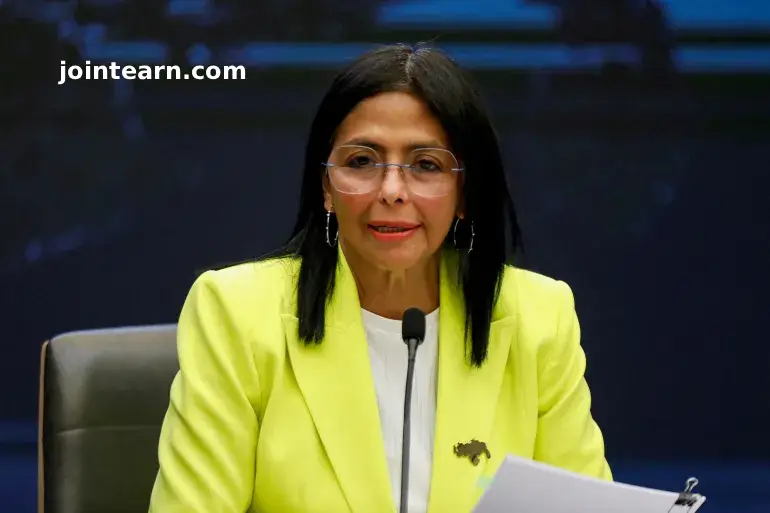
In a significant shift from her initial stance, Venezuela’s interim President Delcy Rodriguez has expressed readiness to engage with the United States in a “balanced and respectful” manner, following the dramatic US military operation that led to the capture of Nicolás Maduro.
Delcy Rodriguez Advocates Cooperation
On Sunday, Rodriguez posted on Telegram:
“We consider it a priority to move towards a balanced and respectful relationship between the US and Venezuela. We extend an invitation to the US government to work together on an agenda for cooperation aimed towards shared development.”
Rodriguez, who served as Maduro’s deputy since 2018, was appointed interim leader by Venezuela’s Supreme Court after the high-profile US operation that detained Maduro and his wife, Cilia Flores. This mission has been described as the riskiest US military operation since the 2011 Navy SEAL raid on Osama bin Laden in Abbottabad, Pakistan.
Initial Denunciation of US Actions
In her first televised address on Saturday, Rodriguez condemned the operation as “an atrocity that violates international law”, insisting that Maduro remains the legitimate president of Venezuela. Her remarks initially created tension with the Trump administration, which had indicated willingness to communicate with Rodriguez.
Following her comments labeling US officials as “extremists,” Trump escalated his rhetoric, warning Rodriguez of potential consequences:
“If she doesn’t do what’s right, she is going to pay a very big price, probably bigger than Maduro.”
The US president also suggested that further strikes in Venezuela were possible and did not rule out the deployment of troops, asserting that the US was now “in charge.”
Formation of Commission to Secure Maduro’s Release
Rodriguez announced the creation of a special commission tasked with seeking the release of Maduro and Flores from US custody. The commission will be co-chaired by Foreign Minister Yvan Gil and Rodriguez’s brother, Jorge Rodriguez, president of Venezuela’s National Assembly.
Maduro faces charges in a New York federal court related to narco-terrorism conspiracy, cocaine importation, and possession of machine guns and destructive devices. Observers have compared his situation to that of Panama’s Manuel Noriega, who was taken by US forces in 1990, convicted on drug and racketeering charges, and later extradited for further sentences abroad.
Context Behind US Intervention
While the Trump administration frames the seizure of Maduro as a law enforcement action to enforce criminal charges from 2020, Trump himself cited additional factors influencing the raid, including:
- A surge of Venezuelan migrants to the US
- Historical nationalization of US oil interests in Venezuela
This intervention has sparked widespread debate, highlighting the complex interplay of US foreign policy, energy interests, and regional security considerations in Latin America.
Strategic and Diplomatic Implications
Rodriguez’s willingness to cooperate with Washington signals a pragmatic approach during Venezuela’s transition period. Observers note that:
- Dialogue could stabilize relations between Venezuela and the US.
- Collaboration may open channels for humanitarian aid and economic recovery.
- The interim administration faces the challenge of balancing domestic legitimacy with international pressures.
Despite these overtures, the Venezuelan population remains wary of foreign intervention, and the international community continues to monitor developments closely.
Key Takeaways
- Delcy Rodriguez appointed interim president after Maduro’s capture.
- Initially denounced US operation as “violation of international law,” but now signals willingness to cooperate.
- US President Trump warned of further strikes and threatened potential consequences.
- A commission has been formed to seek Maduro’s release, co-chaired by Foreign Minister Yvan Gil and Jorge Rodriguez.
- Maduro faces narco-terrorism and weapons charges in New York federal court.
- Observers compare the situation to Manuel Noriega’s capture and prosecution in 1990.
- US intervention reflects longstanding geopolitical and energy interests in the region.


Leave a Reply