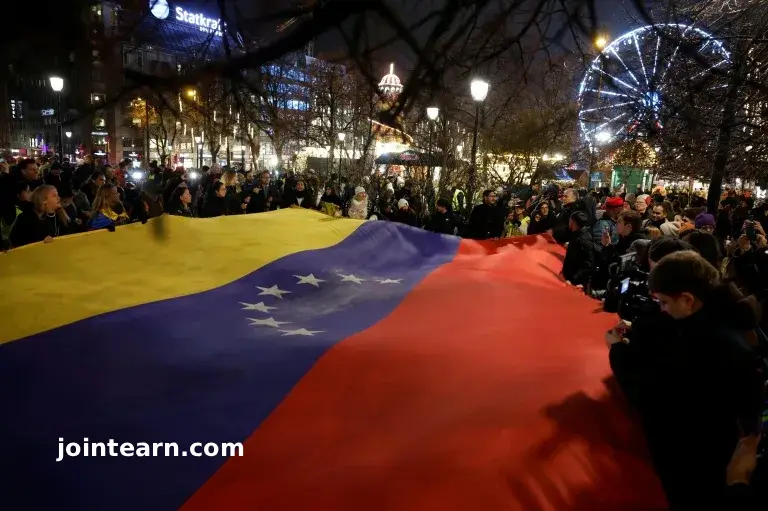
Venezuelan opposition leader Maria Corina Machado has stepped into the global spotlight after nearly a year in hiding, following her award of the Nobel Peace Prize. Machado appeared before supporters in Oslo on Thursday, marking her first public appearance since January and underscoring her role as a symbol of Venezuela’s pro-democracy movement.
Machado’s Dangerous Journey to Oslo
Details remain scarce on how Machado traveled from Venezuela to Norway, a journey the Nobel Institute described as “extremely dangerous.” Despite these risks, Machado insisted on attending the ceremony, though she ultimately arrived too late to collect the prize in person. Her daughter, Ana Corina Sosa Machado, accepted the award on her behalf, delivering a pointed critique of “state terrorism” under President Nicolas Maduro.
In an emotional display, Machado appeared on the balcony of the Grand Hotel, waving and blowing kisses to cheering supporters. AFP journalists reported crowds chanting “libertad” (freedom) as she interacted directly with supporters, many of whom presented her with rosaries and embraced her warmly.
Nobel Peace Prize Honors Machado’s Fight for Democracy
The Nobel Committee recognized Machado for her “struggle to achieve a just and peaceful transition from dictatorship to democracy” in Venezuela. In a statement delivered by her daughter, Machado emphasized the ongoing need for Venezuelans to continue opposing Maduro’s authoritarian rule.
“What we Venezuelans can offer the world is the lesson forged through this long and difficult journey: that to have democracy, we must be willing to fight for freedom,” her daughter declared on her behalf.
Machado’s political activism has included accusations that Maduro stole the July 2024 election, a claim supported by many international observers. Opposition candidate Edmundo Gonzalez Urrutia, who also lives in exile, attended the Oslo ceremony.
Personal Sacrifices and Risks
During her time in hiding, Machado missed major milestones in her children’s lives, including graduations and weddings. “For over 16 months I haven’t been able to hug or touch anyone,” she told the BBC. “Suddenly, in the matter of a few hours, I’ve been able to see the people I love the most, and touch them and cry and pray together.”
Her decision to leave Venezuela for Oslo carries substantial risk. Venezuelan authorities have indicated she could be considered a fugitive upon departure, potentially facing arrest if she returns. According to Benedicte Bull, a Latin America expert at the University of Oslo, “arresting her would have a very strong symbolic value.”
Denouncing Maduro’s Regime
At the Oslo ceremony, Machado highlighted alleged human rights abuses under Maduro, describing kidnappings, torture, and other crimes against humanity as instruments of “state terrorism.” She dedicated her Nobel Prize to her pro-democracy efforts and, controversially, to U.S. President Donald Trump, whom she has publicly supported.
The ceremony coincides with an increased U.S. military presence in the Caribbean, following strikes on vessels alleged to be involved in drug trafficking. Maduro insists these operations aim to destabilize his government and seize Venezuela’s oil reserves.
Political Significance and Future Prospects
Machado’s emergence from hiding reinforces her position as the undisputed leader of Venezuela’s opposition. Experts suggest that prolonged absence from the country could diminish her political influence, but her high-profile Nobel recognition strengthens her international standing.
Among the attendees were Machado’s family and several Latin American leaders, including Argentine President Javier Milei, highlighting regional support for her cause. The award ceremony not only acknowledges her personal bravery but also underscores the ongoing struggle for democracy in Venezuela.
Conclusion
Maria Corina Machado’s return to public life after receiving the Nobel Peace Prize is both a personal triumph and a symbolic victory for Venezuela’s opposition. As she navigates the challenges of leaving her homeland while advocating for democracy, her journey illustrates the risks and sacrifices inherent in the fight against authoritarian regimes.


Leave a Reply