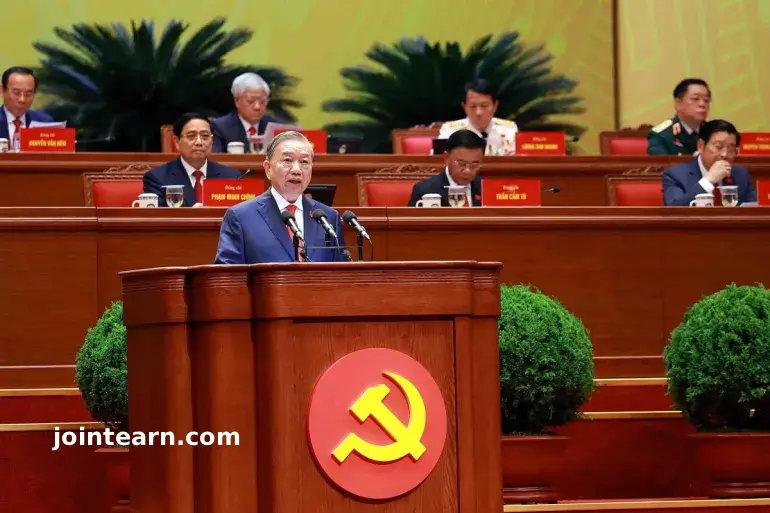
Hanoi, Vietnam – Vietnam’s top Communist Party leader, To Lam, has vowed to tackle corruption and pursue aggressive economic growth of over 10% per year for the remainder of the decade, signaling ambitious reforms for the Southeast Asian nation.
Speaking on Tuesday at the opening session of the 14th National Congress of the Communist Party of Vietnam in Hanoi, Lam emphasized that “all wrongdoings must be dealt with,” while urging officials to cut red tape, improve administrative efficiency, and address waste and inefficiency in government.
Anti-Corruption and Administrative Reform
Lam, 68, highlighted that the party must confront long-standing governance problems and strengthen enforcement of the law. He stressed that Vietnam’s growth depends on transparent governance, administrative reform, and responsible management of public resources.
“Infrastructure must be developed to adapt to climate change and ensure strong regional, interregional, and global connectivity,” Lam said, while underlining the importance of the private sector as a key driver of economic growth.
Since taking office 17 months ago, Lam has centralized authority and pursued sweeping reforms, eliminating entire government departments, cutting nearly 150,000 state jobs, and accelerating ambitious rail and energy projects.
Dual Leadership Role in Consideration
Reports indicate that Lam may retain his position as Communist Party chief while also seeking the state presidency, creating a dual leadership role similar to that of China’s Xi Jinping. If achieved, experts say this would give Lam the strongest mandate in Vietnamese leadership since the end of the Vietnam War, according to Nguyen Khac Giang of Singapore’s ISEAS-Yusof Ishak Institute.
The congress, held every five years, is expected to finalize leadership positions and set economic targets for 2030. According to party documents reviewed by Reuters, the government aims for at least 10% annual growth and stricter enforcement of legal discipline to combat “chronic problems where the law is sound but implementation is weak.”
Economic and Strategic Context
Lam acknowledged that Vietnam faces multiple challenges, including natural disasters, epidemics, security risks, and global supply chain disruptions in energy and food. He emphasized that reforming infrastructure and increasing global trade are essential to protecting Vietnam’s independence and national interests.
“The party is determined to fight corruption, considering that the private sector is an important pillar of the economy,” Lam said.
Analysts note that Lam’s rapid reforms have already reshaped Vietnam’s governance structure and could accelerate economic growth, but the ambitious 10% annual target will require sustained investment, industrial expansion, and effective anti-corruption measures.
National Congress Overview
The weeklong congress, which began on Monday, includes nearly 1,600 party delegates and will shape Vietnam’s political and economic agenda for the next five years. Party submissions call for reforms to overcome “much talk, little action,” and restore public trust while efficiently using national resources.
With these pledges, Lam is positioning himself as a reformist yet powerful leader with a focus on economic modernization, anti-corruption policies, and administrative efficiency—all amid complex domestic and international challenges.


Leave a Reply