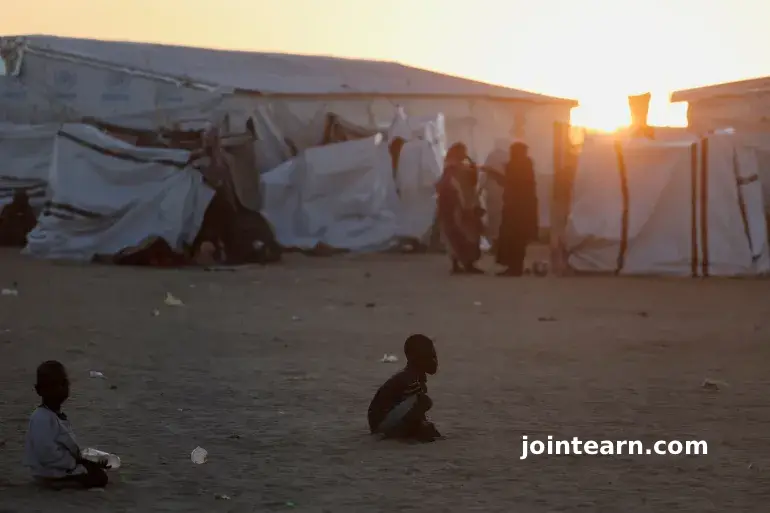
Thousands of Sudanese families continue to pour across the border into neighboring Chad as the civil war between the Sudanese Armed Forces (SAF) and the Rapid Support Forces (RSF) intensifies. With violence spreading across Darfur and other regions, many families say they have no choice but to flee, hoping to find safety and food — even as Chad itself faces extreme poverty and strained resources.
According to the United Nations, more than 4.3 million Sudanese have escaped to nearby countries since fighting erupted in April 2023, fueling what global humanitarian agencies now call the world’s largest displacement crisis. Nearly 12 million people have been forced from their homes due to conflict, hunger, and mass killings, creating severe pressure on Sudan’s neighbors.
Refugees Arrive in Chad to Face a Country Already in Crisis
Tine, a border town straddling Sudan and Chad, has become one of the busiest entry points for families escaping the war. Every day, dozens of new families arrive, joining the more than one million Sudanese refugees who have already crossed into Chad since the conflict began.
But Chad — one of the poorest countries in the world — was already struggling long before the war in Sudan escalated. Approximately seven million people, including millions of children, depend on humanitarian aid to survive. The influx of refugees is pushing already fragile systems to the breaking point.
Tine resident Abdulsalam Abubakar told Al Jazeera that prices for food and essential supplies have risen dramatically.
“Everything in the market here is expensive; nothing is cheap,” he said, explaining that the same amount of money buys significantly less than it did just days before.
Market traders say they are not intentionally raising prices but that the massive boost in demand is overwhelming local supply chains.
“More than 10,000 Sudanese arrived here after their country disintegrated,” said food seller Khadijah Kurgule. “There are goods everywhere, but people can’t afford them.”
Escaping Mass Killings Only to Confront New Hardships
Many families crossing into Chad fled the RSF-led violence and mass killings around the city of el-Fasher in Sudan’s Darfur region, where fighting has intensified in recent weeks. The renewed wave of refugees has added extraordinary pressure to already packed camps and communities along the border.
Al Jazeera correspondent Ahmed Idris reports that constant refugee arrivals are increasing competition for food, water, and shelter.
Humanitarian groups warn that these shortages could create tensions between refugees and the local Chadian population — both of whom desperately need support.
Long lines for water and food distribution have become routine. Hospitals and makeshift clinics are stretched far beyond their capacity, and schools in the region are overwhelmed.
Children Make Up Majority of New Arrivals
The United Nations High Commissioner for Refugees (UNHCR) reports that 57 percent of new Sudanese arrivals are school-age children. But there are no formal classrooms for them, and funding shortages have left humanitarian workers unable to build temporary learning centers or hire teachers.
“We don’t have the funding to construct even temporary learning spaces,” said UNHCR representative John-Paul Habamungu. “We don’t have the means to recruit teachers.”
To ease overcrowding, aid groups have begun relocating thousands of refugees to other parts of eastern Chad — but the war in Sudan shows no signs of slowing, raising fears that another massive wave of displacement may be imminent.
International Response: EU Sanctions RSF Leadership
As the conflict worsens, the international community is increasing pressure on those involved in atrocities. On Thursday, the European Union announced sanctions against Abdul Rahim Hamdan Dagalo, deputy leader of the RSF and brother of commander Mohamed Hamdan “Hemedti” Dagalo.
The sanctions include an EU-wide travel ban, asset freeze, and a prohibition on conducting financial transactions within the bloc.
“This sends a signal that the international community will come after those who are responsible,” said EU foreign policy chief Kaja Kallas.
Humanitarian workers warn, however, that sanctions alone will not slow the flow of refugees — and that the world must urgently address the escalating crisis before it spirals even further.


Leave a Reply