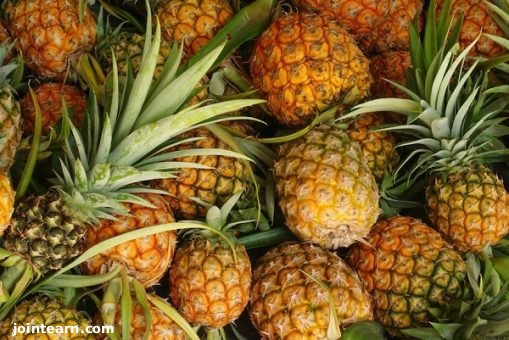
Nigeria is missing out on the rapidly expanding $27.08 billion global pineapple market due to low-value exports and massive post-harvest losses, according to Okekunle Akintunde, Chairman of the Board of Trustees, National Pineapple Growers, Processors and Marketers Association of Nigeria.
Despite producing 1.54 million tonnes of pineapple annually, the country captures only a tiny fraction of the global market because most farmers sell their produce raw—leaving huge opportunities untapped and allowing millions of tonnes to rot before reaching consumers or processors.
Post-Harvest Waste: A Major Economic Loss
Akintunde lamented that Nigeria’s inability to process its pineapples is costing the economy billions.
“What Nigeria loses annually to post-harvest waste in the pineapple subsector can significantly boost GDP if properly managed,” he said.
Farmers, he explained, lack modern storage systems, cold-chain facilities, and processing equipment—forcing them to sell at low prices or lose their produce entirely.
Global Demand Rising — But Nigeria Isn’t Benefiting
Analysts note that the Middle East’s processed fruit market—driven by soaring demand for juices, dried fruits, and canned products—is projected to grow at 5.3% CAGR through 2026.
Major importers such as Saudi Arabia and the UAE already spend tens of millions of dollars annually on fruit and fruit juices.
Akintunde stressed that the real profits lie in value-added processing, not fresh fruit exports:
“At certain market levels, it is more profitable to sell to processors than to the fresh export market.”
He argued that Nigeria must position itself as a leading global hub for processed pineapple products to unlock opportunities in Europe, the Middle East, and Asia.
Huge Investment Gap Holding Nigeria Back
Recalling a 2019 market survey in the UK, Akintunde noted that even Europe relies heavily on imports from countries like Costa Rica and Hawaii, raising the price of each fruit significantly.
The major constraint, however, is the cost of processing machinery.
“The machine to produce raw juice—no concentrate, no additive—was around ₦180 million in 2019. There is no single person producing raw pineapple juice in Nigeria today.”
He said Nigeria urgently needs investments in storage, processing plants, cold-chain systems, and modern packaging facilities to compete globally.
A High-Return Crop With Untapped Potential
Akintunde described pineapple farming as one of the most profitable agricultural ventures in the tropics:
- Cost of sucker: ₦150–₦200
- Market price of mature fruit: ₦1,000–₦1,500 (and up to ₦2,000 depending on location)
Unlike planting the crown—which takes nearly three years to fruit—pineapple suckers mature in under two years.
A Natural Barrier Against Cattle Invasion
Akintunde also highlighted an unexpected advantage: pineapple farms naturally deter grazing cattle.
“The plant’s thorns prevent cows from entering the plantation. If you plant two or three rows of pineapple around cassava, cattle won’t be able to penetrate the farm.”
He recommended the crop as a cheap, effective way for farmers to protect their fields from herders.
Charting the Path Forward
To participate meaningfully in the global pineapple value chain, Akintunde said Nigeria must:
- Reduce post-harvest waste through modern storage and cold-chain infrastructure
- Invest in processing plants to produce juice, concentrates, dried pineapple, and canned products
- Support farmers with access to finance, modern tools, and training
- Build partnerships targeting high-demand markets in Europe and the Middle East
He concluded that transforming Nigeria’s pineapple industry from raw production to processing could unlock billions in annual revenue, create jobs, and significantly strengthen the nation’s GDP.


Leave a Reply