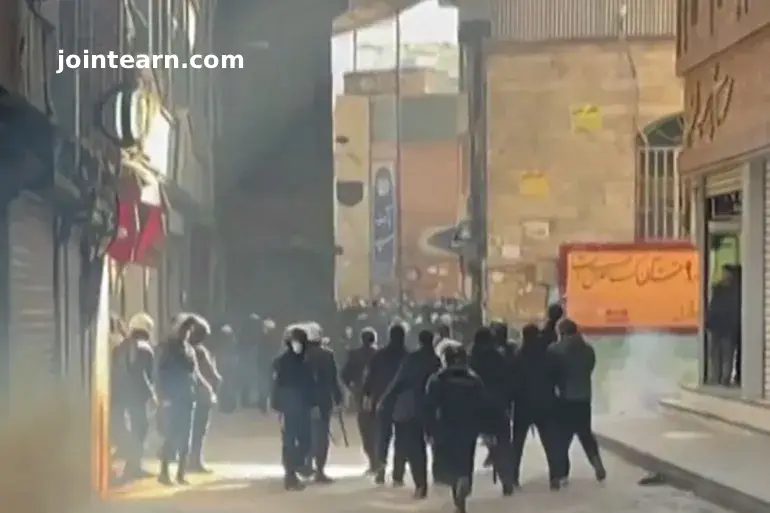
Tehran, Iran – Mass protests are escalating across Iran as the government struggles to contain a deepening economic crisis. Security forces have been deployed in increasing numbers to major cities, but demonstrators continue to flood the streets, highlighting growing public anger over skyrocketing prices, a collapsing currency, and government mismanagement.
Major Protests Across Iranian Cities
Videos circulating online show thousands of Iranians taking to the streets in cities such as Abdanan, Ilam, Tehran, Mashhad, Qazvin, Shahrekord, Hamedan, and Lorestan. Protesters include men, women, and children, marching with chants demanding freedom and economic justice.
In Abdanan, helicopters hovered over the crowd as protesters outnumbered security forces. In Tehran, traders and business owners at the historic Grand Bazaar clashed with riot police, with demonstrators shouting slogans like “Neither Gaza nor Lebanon; my life for Iran” in criticism of government foreign policies.
Crackdown on Hospitals and Protests
In Ilam, security forces stormed Imam Khomeini Hospital to target injured protesters, prompting condemnation from Amnesty International, which said the raid violated international law. Earlier in the week, multiple protesters were shot during demonstrations in Malekshahi near a military base, with some victims brought to the hospital for treatment.
State-linked media confirmed at least three deaths in these clashes, while foreign-based human rights monitors estimate at least 35 fatalities so far, though exact numbers remain unverified.
Government Response and Hardline Statements
Supreme Leader Ayatollah Ali Khamenei condemned the protesters, saying rioters must be “put in their place,” while Chief Justice Gholamhossein Mohseni-Ejei declared authorities would “show no mercy.”
Despite warnings, protests continue, with participants closing shops, clashing with security forces, and defying water cannons and tear gas in cities across the country.
Economic Collapse Fuels Unrest
The protests are fueled by a plummeting Iranian rial and soaring inflation. On January 6, 2026, the rial traded at over 1.47 million to the US dollar, an all-time low reflecting public and investor distrust.
Cooking oil prices have more than tripled, further straining the middle class. The government’s elimination of a subsidized currency rate—used for importing essential goods—has exacerbated price spikes, despite its goal to curb corruption.
To ease the crisis, the government has introduced online credits worth 10 million rials ($7) per person to help citizens purchase food, but the measure is widely regarded as insufficient against rapidly increasing costs.
Public Figures Join Protests
Prominent Iranian figures, including singers Homayoun Shajarian and Alireza Ghorbani, have canceled concerts in solidarity with the protests. Football legend Ali Daei condemned officials for being indifferent to the struggles of ordinary Iranians, questioning their loyalty to the nation in a video widely shared on social media.
The Wider Context
The unrest highlights deep-seated frustration over decades of economic mismanagement, compounded by international sanctions and the government’s spending on foreign conflicts in Gaza and Lebanon. The protests reflect both political dissent and public outrage over an economy that has steadily worsened since the US withdrawal from the 2015 nuclear deal in 2018.
Analysts warn that if inflation continues to spiral and the rial collapses further, protests could intensify, with potential for prolonged civil unrest.


Leave a Reply