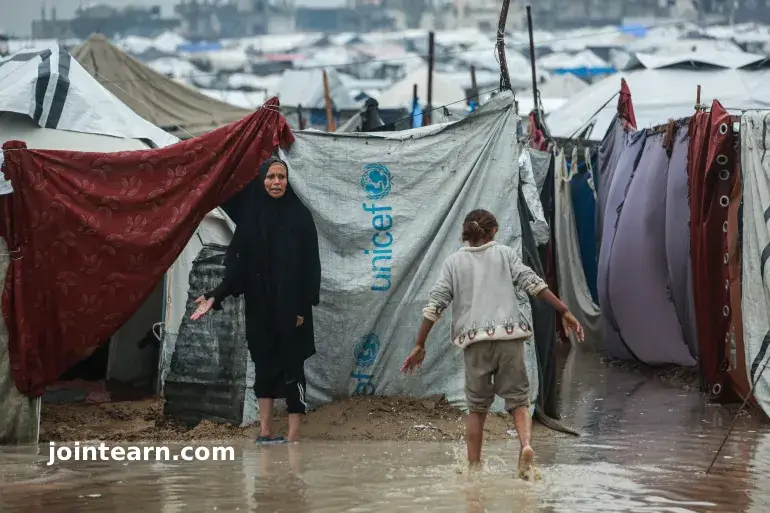
Winter Weather Devastates Displaced Palestinians in Gaza
Severe winter storms are compounding the humanitarian catastrophe in Gaza, where hundreds of thousands of displaced Palestinians are struggling to survive amid flooding, collapsing shelters, and freezing temperatures. Aid agencies and the United Nations warn that Israeli restrictions on border crossings are preventing critical shelter supplies from reaching civilians in desperate need.
Heavy rainfall and strong winds have damaged makeshift tents, destroyed personal belongings, and left families exposed to the cold across the besieged enclave, particularly in overcrowded displacement camps.
UN Says Lifesaving Aid Is Ready but Still Blocked
The United Nations has confirmed that it has tents, blankets, plastic sheeting, and winter clothing prepared for delivery into Gaza. However, UN officials say Israeli authorities continue to block or severely restrict access, delaying the distribution of essential humanitarian assistance.
A spokesperson for UN Secretary-General Antonio Guterres said the winter storms have significantly worsened conditions for vulnerable populations, especially children.
“The disruption has affected approximately 30,000 children across Gaza,” spokesperson Farhan Haq said. “Urgent repairs are needed to ensure these activities can resume without delay.”
Shelter Collapses Highlight Growing Danger
In Shati refugee camp in Gaza City, the roof of a war-damaged family home collapsed during the storm, according to Palestinian rescue services. Six people, including two children, were pulled alive from the rubble, underscoring the extreme risks facing families sheltering in damaged buildings.
Gaza’s Ministry of Health also reported that a two-week-old infant died from exposure to the cold, a tragic illustration of the dangers faced by newborns and the elderly living in inadequate housing.
The Palestinian Civil Defence described the situation in stark terms, saying Gaza is facing “a true humanitarian catastrophe” as winter weather collides with ongoing shortages of shelter, fuel, and medical supplies.
Ceasefire Talks Amid Mounting Humanitarian Pressure
The worsening conditions come as Qatar’s Prime Minister Sheikh Mohammed bin Abdulrahman bin Jassim Al Thani met US Secretary of State Marco Rubio in Washington, DC, to discuss efforts to stabilise the fragile ceasefire in Gaza.
Qatari officials said discussions focused on:
- Ensuring unrestricted humanitarian access
- Strengthening Qatar’s mediation role
- Advancing negotiations toward the second phase of a US-backed ceasefire plan
Reporting from Washington, Al Jazeera’s Alan Fisher said Sheikh Mohammed emphasised that aid must enter Gaza “unconditionally”, echoing concerns raised by multiple international aid agencies.
Calls for Progress on Second Phase of Ceasefire
The Qatari prime minister also urged swift movement toward the next stage of the ceasefire agreement, warning that delays would further endanger civilian lives.
Discussions reportedly included the possibility of deploying an international stabilisation force in Gaza following the war. Sheikh Mohammed stressed that any such force must operate impartially and focus on maintaining security rather than political objectives.
US officials are said to be exploring which countries could contribute troops if the plan moves forward.
Violence Continues Despite Truce
Despite ceasefire efforts, violence has continued across Gaza. Medical sources reported that at least 11 Palestinians were wounded in Israeli attacks in central Gaza City.
The Israeli military said it is investigating an incident in which a mortar shell fired near Gaza’s so-called “yellow line” missed its intended target. Al Jazeera journalists also reported Israeli artillery fire east of Khan Younis and gunfire injuries in the Tuffah neighbourhood of eastern Gaza City.
In the occupied West Bank, Israeli forces shot and wounded a man in his 20s in Qalqilya, according to Palestinian news agency Wafa. He was taken to hospital and is reported to be in stable condition.
Mounting Civilian Toll
Since October 2023, Palestinian health authorities say at least 70,668 Palestinians have been killed and more than 171,000 wounded in Israeli attacks on Gaza. In Israel, 1,139 people were killed during the Hamas-led October 7 attack, and more than 200 people were taken captive.
Humanitarian agencies warn that without immediate and unrestricted aid access, winter conditions will continue to claim lives and deepen suffering across Gaza’s displaced population.
Conclusion
As winter storms batter Gaza, the humanitarian crisis is reaching new levels of urgency. With shelters collapsing, children exposed to freezing temperatures, and aid supplies blocked at crossings, international pressure is mounting to ensure that lifesaving assistance reaches civilians without delay. Aid groups warn that time is running out as weather conditions worsen and displacement camps remain dangerously unprepared for winter.


Leave a Reply