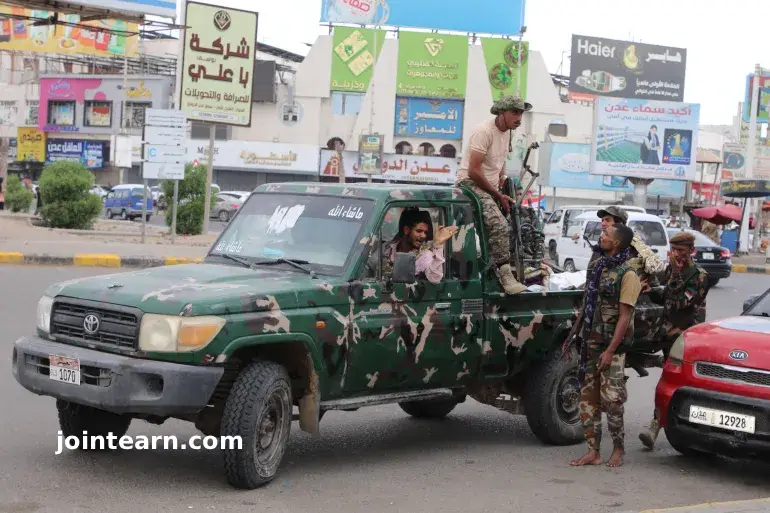
Sanaa, Yemen – The Yemeni government has regained momentum in the south after years of fragmentation and internal conflict, setting its sights on the Houthi rebels in northern Yemen. Following the collapse of the Southern Transitional Council (STC), the Presidential Leadership Council (PLC) is consolidating military command, raising hopes among government forces for a more unified approach to reclaiming territory.
STC Collapse and Government Gains
For nearly a decade, Yemen’s war against the Houthis has been hampered by internal divisions. Many southern fighters previously supported the UAE-backed STC, which often pursued its own separatist agenda. According to Naef, a government soldier with nine years of experience, the lack of unified command was a key reason for repeated setbacks.
However, recent events have shifted the balance. The STC’s attempt to seize full control of southern and eastern Yemen backfired, and Saudi-backed pro-government forces pushed the separatist group back. The STC is now divided, with one leader fleeing the country and others declaring the organization dissolved.
“I am optimistic today as the government has revived some of its power in southern Yemen,” Naef told Al Jazeera.
“The formation of an inclusive military committee is a boost to our morale and a prelude to a powerful government comeback.”
Formation of the Supreme Military Committee
On January 10, 2026, President Rashad al-Alimi and the PLC established the Supreme Military Committee (SMC) to oversee all anti-Houthi forces and integrate them into the official Yemeni military under one command.
Al-Alimi said the committee would serve as a vehicle to defeat the Houthis and eventually reclaim all Yemeni territory. Analysts view the SMC as a potential turning point in a decade-long conflict that has left Yemen fragmented and its population suffering.
Concerns Among Houthi Supporters
The SMC’s formation has sparked concern in Houthi-controlled northern Yemen. Hamza Abdu, a 24-year-old Houthi supporter in Sanaa, described the committee as an effort to organize southern proxies and warned that it could trigger renewed conflict:
“If this military committee succeeds in uniting the forces in the south, that might entice them to attack the north. A new destructive war will begin, and the humanitarian ordeal will magnify.”
Pro-Houthi military experts argue that the SMC will not weaken their position. Aziz Rashid stated that Houthi forces have historically confronted powerful international actors, including the United States, Britain, and Israel, and emerged resilient. Rashid stressed that the only sustainable solution for Yemen is a political settlement, not continued military escalation.
Strategic Opportunities for the Yemeni Government
The collapse of the STC and the SMC’s formation have opened new opportunities for the Yemeni government, according to analysts:
- Adel Dashela, a researcher at MESA Global Academy, said that effective integration of anti-Houthi forces could improve security in southern territories and strengthen the government’s negotiating position.
- Abdulsalam Mohammed, head of the Abaad Studies and Research Center, highlighted that recent successes in the south send a message of vulnerability to the Houthis in the north.
Factors that may favor the government include Iran’s internal crises, growing popular discontent against Houthi governance, and the UAE’s exit from southern operations, allowing a shift in focus to northern fronts.
Local Populations Hope for Stability
Residents in southern cities such as Aden are hopeful that the SMC will restore law and order. Fawaz Ahmed, a local resident, cited past incidents of infighting among armed groups that paralyzed public services and caused civilian hardship.
“We are desperate for law and order… Only united military leadership can achieve this,” Fawaz said.
The SMC aims to end unlawful money collection, prevent inter-unit clashes, and bring southern cities under coordinated military governance—an important step toward stabilizing government-held areas.
Challenges Ahead
Despite recent gains, defeating the Houthis in northern Yemen remains a formidable challenge. The group has gained combat experience, advanced weapons, and drones over the past decade, and past coalition air campaigns have failed to dislodge them.
Analysts emphasize that a successful campaign will require both military coordination and political strategy, with an eye on eventual negotiations. If peaceful solutions fail, the government may pursue targeted operations to reclaim territory, while aiming to minimize civilian impact.


Leave a Reply