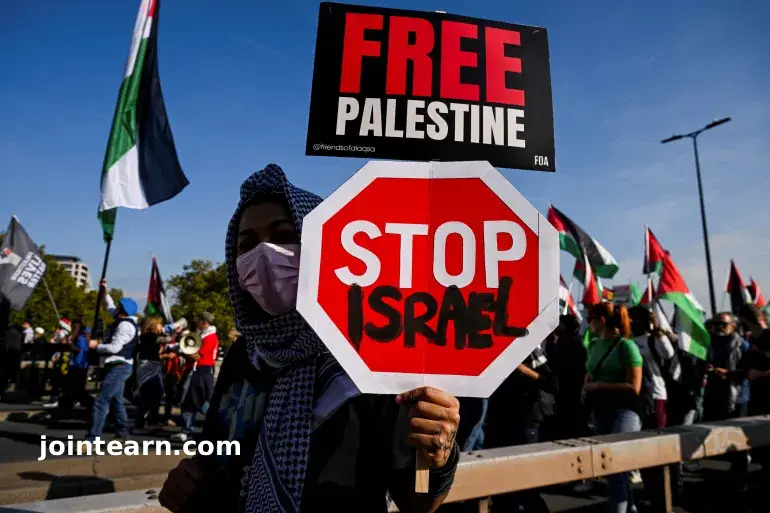
Police in the United Kingdom have arrested four individuals during pro-Palestinian demonstrations in London, marking the first arrests following the government’s announcement to clamp down on public calls to “globalise the Intifada.” The arrests came amid heightened tensions after Australia’s Bondi Beach attack, which authorities controversially linked to largely peaceful protests supporting Palestine.
Arrests at Westminster Protest
The arrests took place outside the Ministry of Justice in Westminster during a demonstration supporting eight imprisoned hunger strikers associated with the Palestine Action group. London’s Metropolitan Police reported that all four individuals were detained for allegedly shouting or chanting slogans involving calls for intifada.
The protest aimed to raise awareness about the hunger strikers, whose health is reportedly in critical condition due to prolonged strikes. Authorities justified the arrests as part of a broader crackdown on rhetoric they deem to incite violence.
Government and Police Response
Following the arrests, the UK Safeguarding Minister Jess Phillips publicly supported the police action, stating that the slogans could be interpreted as inciting violence. She told The Times of London:
“I cannot think of any interpretation other than that [it] is inciting people to violence, which has the terrible consequences.”
In a joint statement, commanders from the Metropolitan Police (Met) and Greater Manchester Police (GMP) explained:
“Violent acts have taken place, the context has changed – words have meaning and consequence. We will act decisively and make arrests.”
These comments came in the wake of recent violent incidents, including a father-and-son attack at a Hanukkah festival in Sydney, which killed 15 people, and an October assault on a Manchester synagogue during Yom Kippur.
Palestinian Perspective on ‘Intifada’
Critics of the police crackdown argue that the term “Intifada” has been misrepresented. Ben Jamal of the Palestine Solidarity Campaign explained that in Arabic, “intifada” translates to “uprising” or “shaking off injustice.”
In the Palestinian context, it refers to civil resistance against military occupation and the expansion of illegal settlements. Historically, the term was associated with uprisings between 1987-1993 and 2000-2005, during which thousands of Palestinians were killed by Israeli forces.
Jamal criticized authorities for using the Bondi Beach attack as a pretext to curb legitimate protest against Israel, describing it as an attempt to delegitimize advocacy against what he called “open genocide.”
Reactions from Jewish and Muslim Communities
The arrests have drawn mixed reactions. Jewish groups, including the UK’s Chief Rabbi Ephraim Mirvis and the Community Security Trust (CST), praised the police for taking action against rhetoric that could inspire violence or terror.
Meanwhile, critics highlight that attacks and discrimination against Muslims have risen in the UK, often fueled by Islamophobic rhetoric in mainstream politics. Analysts point to parties like Nigel Farage’s Reform Party as contributing to an increasingly hostile environment for British Muslims.
International and Local Implications
The crackdown reflects the UK government’s attempt to balance public safety with freedom of expression, amid rising global scrutiny of the Gaza conflict and its humanitarian toll. With the Gaza death toll surpassing 70,000, tensions remain high, and protests supporting Palestine continue across Europe and North America.
Conclusion
The arrests at the Westminster protest illustrate the UK’s complex struggle with freedom of speech, public safety, and international politics. While authorities argue that the measures are necessary to prevent violence, advocacy groups contend that peaceful pro-Palestinian demonstrations are being unfairly targeted.


Leave a Reply