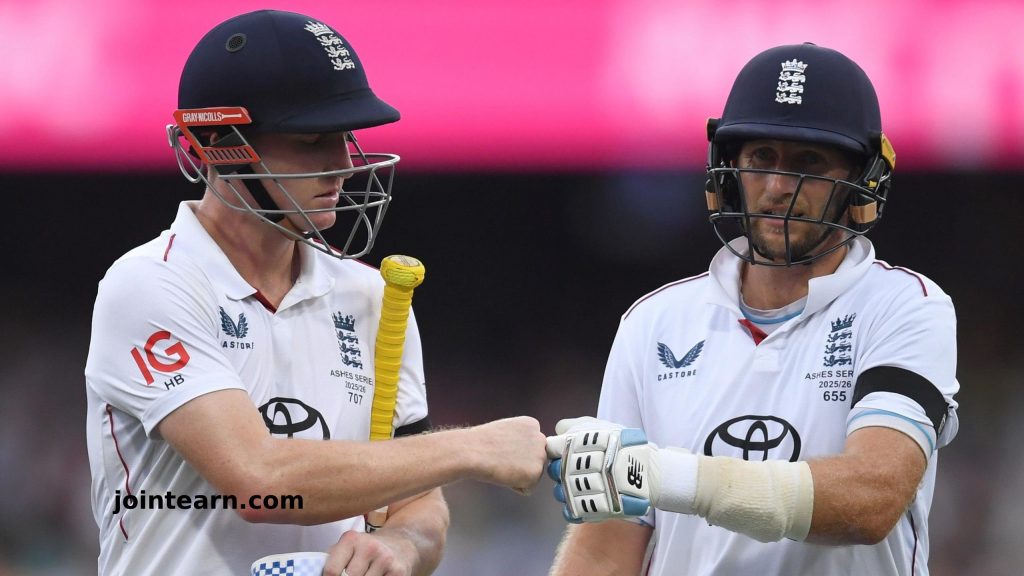
Former England captain Michael Vaughan believes England should continue to back Zak Crawley as an opener, despite admitting the right-hander remains one of the most frustrating batters he has ever watched at Test level.
Crawley began the final Ashes Test in Sydney as England’s leading run-scorer in the series, yet once again failed to convert a promising start, falling lbw for 16 on the opening morning at the Sydney Cricket Ground. His dismissal came after a technical tweak, with the 27-year-old shifting his guard across the stumps in an attempt to counter Australia’s bowlers.
Facing seamer Michael Neser, Crawley played across a straight delivery that jagged back slightly, trapping him leg-before. For Vaughan, it was another example of a batter whose talent far outweighs his returns.
“He looks such a good player – and then just gets out,” Vaughan said on the Test Match Special podcast. “The ball that got him out should not have got him out. There must be something in his concentration.”
A Series of Contrasts for Crawley
Crawley’s Ashes campaign has been one of extremes. He opened the series disastrously with a pair in the first Test in Perth, facing just 11 balls across the entire match. Since then, however, he has been one of England’s more reliable run-scorers.
He responded with scores of 76 and 44 in Brisbane, followed by a gritty 85 in the second innings in Adelaide, where England were under sustained pressure. His 37 at the top of the order in Melbourne proved crucial as England secured their first Test victory in Australia for 15 years, narrowing the series scoreline to 3-1.
Yet consistency remains elusive, and his Sydney dismissal reignited debate over his place in the side.
Technique Improved, Concentration Still the Issue
Vaughan acknowledged Crawley has made clear technical improvements since the start of the tour, particularly in curbing his tendency to chase deliveries outside off stump.
“If you go back to the start of the series where he was playing the big booming drives, those shots have gone,” Vaughan explained. “He’s not chasing the ball outside off stump anymore. That’s progress.”
However, Vaughan believes concentration—not technique—is the major obstacle preventing Crawley from becoming a top-class Test opener.
“Today, that should not get you out as a quality opening batter,” he added. “It’s about maintaining focus ball after ball.”
A Career Defined by Opportunity
Crawley returned to the SCG hoping to rekindle memories of his impressive 77 in the 2021–22 Ashes, an innings widely regarded as the moment his Test career truly began.
Since then, he has now opened the batting in 103 Test innings, recording an average of 30.82—the lowest average of any player in Test history to have had as many opportunities at the top of the order.
Despite those numbers, Vaughan insists statistics alone do not tell the full story.
“I hear fans saying Crawley averages 30, but there’s a bigger average in him than he’s giving at the moment,” he said. “There’s a lot more in the tank.”
Why England Should Stick With Crawley
Vaughan, who himself made three Ashes centuries as an opener during the 2002–03 tour, believes England would be wrong to abandon Crawley now—especially given his recent contributions in Australia.
“I do think England have to stay with him,” Vaughan said. “The movement he had today was fantastic, but he needs to understand the concentration levels required at this level.”
According to Vaughan, Crawley has the potential to lift his average into the 40–45 range over the next few years if he can sharpen his mental discipline.
“If he can find that concentration,” Vaughan concluded, “I genuinely believe he can be a top-class Test opener.”
A Defining Period Ahead
With England entering a rebuilding phase following another Ashes defeat in Australia, Crawley’s future will remain under scrutiny. But for now, the message from one of England’s most successful former captains is clear: talent of this level deserves patience.
Whether Crawley can finally align his obvious ability with sustained consistency may determine not only his own future, but also England’s long-term stability at the top of the order.


Leave a Reply