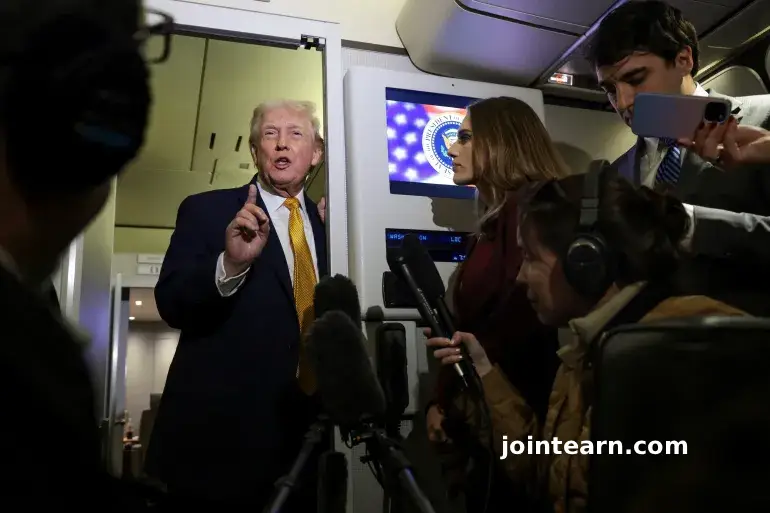
US President Donald Trump has escalated tensions across Latin America, issuing threats against Colombian President Gustavo Petro and claiming that Cuba’s government is on the verge of collapse. His comments follow the controversial US abduction of Venezuelan President Nicolas Maduro, which has drawn widespread condemnation across the region and beyond.
Trump Targets Latin American Leaders
Speaking aboard Air Force One on Sunday, Trump described Venezuela and Colombia as “very sick” countries, criticizing Petro as “a sick man who likes making cocaine and selling it to the United States.”
When asked whether the US might carry out a military operation in Colombia, Trump responded:
“Sounds good to me.”
Petro immediately responded, urging Trump to “stop slandering” him and calling on Latin American nations to unite. In a series of posts on X, the Colombian leader highlighted that the US had set a dangerous precedent by bombing a South American capital and stressed that regional cooperation is the key to stability.
“We do not look only to the north, but in all directions,” Petro said, calling for strengthened trade and diplomacy across Latin America.
Cuba ‘Ready to Fall,’ Says Trump
Trump also turned his attention to Cuba, asserting that the island nation is “ready to fall” due to its dependence on Venezuelan oil.
“Cuba now has no income. They got all of their income from Venezuela. They’re not getting any of it. Cuba literally is ready to fall,” he said.
The US and Cuba have a long history of strained relations dating back to the 1959 revolution led by Fidel Castro. Trump suggested that while Cuba may collapse on its own, US intervention could occur if necessary, though he framed it as currently unnecessary.
Mexico Warned Over Drug Trafficking
Trump also issued a stern warning to Mexico, claiming that the US might intervene militarily if the country fails to curb drug trafficking. He praised Mexican President Claudia Sheinbaum as capable but emphasized that the strength of cartels has hindered enforcement.
“They’re [drugs] pouring through Mexico and we’re going to have to do something,” Trump said, reaffirming his willingness to send US troops if needed.
US Actions in Venezuela Spark Regional and Global Backlash
The abduction of Maduro by US forces in Caracas on Saturday has drawn international criticism, with countries including Brazil, Chile, Colombia, Mexico, Uruguay, and Spain condemning the operation as a “dangerous precedent for peace and regional security.”
“These actions contravene fundamental principles of international law… and endanger the civilian population,” the joint statement said.
Critics argue that Trump’s motives extend beyond law enforcement, pointing to Venezuela’s vast oil reserves as a primary objective of US intervention.
Trump has reiterated that the US remains “in charge” of Venezuela, even as Vice President Delcy Rodriguez assumes the role of interim leader. He also threatened additional military action if the Venezuelan government does not comply with Washington’s demands.
Trump’s Latin American Agenda
Analysts note that Trump’s recent threats and operations reflect a broader agenda to reshape political dynamics in Latin America:
- Backing right-wing leaders such as Javier Milei in Argentina.
- Supporting pardons for controversial figures like ex-Honduran President Juan Orlando Hernandez.
- Applying pressure on left-wing governments, including Colombia and Brazil.
David Smith, associate professor at the University of Sydney’s US Studies Centre, explained:
“Trump hopes these short, spectacular displays of force, like the bombing in Iran and the operation in Venezuela, will scare other countries into compliance without prolonged conflict.”
Cuba and the Monroe Doctrine Revisited
Trump has framed his Latin American strategy as a revival of the 19th-century Monroe Doctrine, which posits US dominance in the Western Hemisphere. He calls his modern approach the “Don-roe Doctrine”, emphasizing US interventionism in response to perceived regional instability.
Political scientist Matthew Wilson noted that Cuba remains the top concern for US policymakers due to longstanding grievances and the influence of a mobilized Cuban-American constituency in the United States.
Key Takeaways
- Trump has threatened military action against Colombia while warning that Cuba may collapse.
- Latin American leaders, including Petro, have called for regional unity in response to US actions.
- The abduction of Maduro is part of a broader strategy to secure Venezuelan oil and exert US influence in Latin America.
- Trump’s administration is pursuing a concerted agenda to promote right-wing governments while weakening leftist regimes.
- International condemnation underscores the risk of destabilization and a dangerous precedent for future military interventions.


Leave a Reply