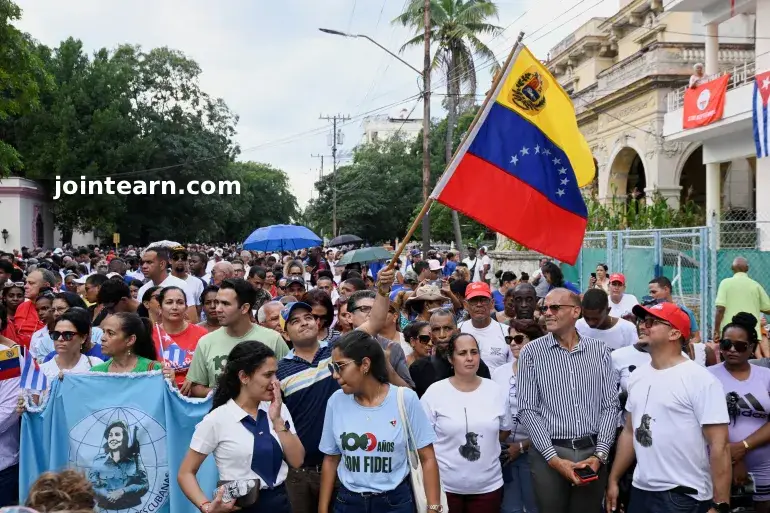
Cuba has confirmed the deaths of 32 Cuban fighters during the United States military operation to abduct Venezuelan President Nicolas Maduro and his wife in Caracas. In response, Havana has declared two days of national mourning on January 5 and 6, 2026, with funeral arrangements forthcoming.
Cuban Fighters Killed in US Operation
According to state-run Prensa Latina, the Cuban nationals were killed while “carrying out missions” requested by the Venezuelan government. The agency reported that the fighters “fell in direct combat against the attackers or as a result of the bombing of the facilities” after offering “fierce resistance.”
Cuba has been a close military ally of Venezuela for years, sending troops and police to support operations and security efforts in the Latin American nation.
Maduro and His Wife Detained
Following the US operation, Maduro, 63, and his wife were flown to New York to face prosecution on drug-related charges. The Venezuelan leader has repeatedly denied involvement in criminal activity. His court appearance is scheduled for Monday, January 6, 2026.
Images of Maduro blindfolded and handcuffed during the operation have stunned Venezuelans and drawn global attention.
Venezuelan Casualties and Security Losses
Venezuelan Minister of Defence General Vladimir Padrino reported that US attacks killed soldiers, civilians, and “a large part” of Maduro’s security detail. Although he did not provide exact numbers, sources cited by the New York Times estimate at least 40 casualties in total, highlighting the scale of the raid.
US President Donald Trump confirmed on Air Force One that “a lot of Cubans” were killed, while claiming that no US personnel were harmed during the operation.
Trump’s Threats Against Colombia and Comments on Cuba
Trump used the operation to issue threats to Colombian President Gustavo Petro, suggesting a US military intervention “sounds good” to him. He also reiterated that Cuba “looks ready to fall,” citing the loss of Venezuelan oil as a key factor in the island nation’s economic decline.
“Cuba now has no income. They got all of their income from Venezuela, from the Venezuelan oil,” Trump said.
“They’re not getting any of it. Cuba literally is ready to fall. And you have a lot of great Cuban Americans that are going to be very happy about this.”
Despite his rhetoric, Trump implied that a direct US intervention in Cuba is unlikely because the country is already destabilized.
International Reactions
The US raid on Venezuela is the most controversial intervention in Latin America since the invasion of Panama in 1989. While the Trump administration describes the operation as a law-enforcement mission to prosecute Maduro on charges of narco-terrorism, critics argue it represents a violation of international law and the sovereignty of a foreign state.
Left-leaning governments in Brazil, Colombia, Chile, and Mexico have condemned the operation, calling it a dangerous precedent for regional peace and stability. Meanwhile, right-leaning governments in Argentina and Ecuador have largely welcomed the action.
The United Nations Security Council is scheduled to meet to discuss the attack. Russia and China, both close allies of Venezuela, have criticized the US. Beijing emphasized the need to prioritize Maduro’s safety and called the raid a violation of international law. Moscow condemned the operation as an “act of armed aggression” against Venezuela.
Strategic Motives Behind the US Operation
Observers suggest the operation reflects multiple US strategic goals, including:
- Securing access to Venezuela’s vast oil reserves.
- Controlling the influx of Venezuelan immigrants to the US.
- Exerting influence across Latin America under Trump’s modernized Monroe Doctrine, dubbed the “Don-roe Doctrine.”
The deaths of Cuban fighters and Venezuelan casualties underscore the human cost of unilateral military interventions and highlight the risks of escalating regional tensions.


Leave a Reply