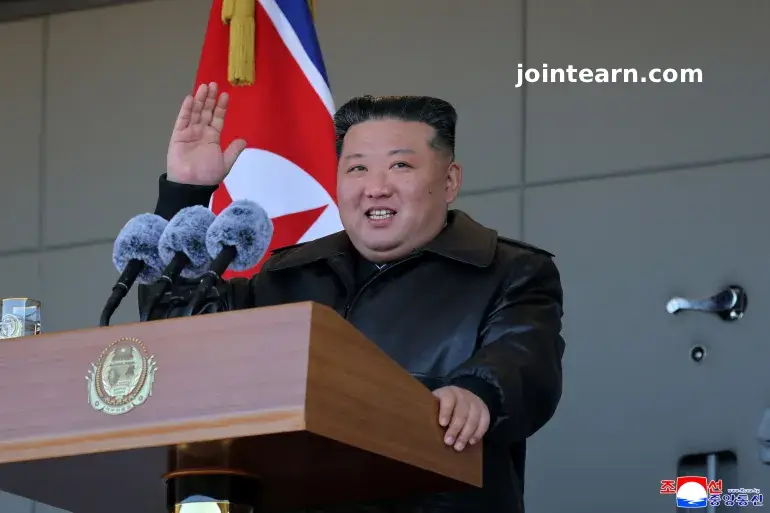
North Korean leader Kim Jong Un has personally overseen the test flights of hypersonic missiles, citing the need to strengthen Pyongyang’s nuclear deterrent in response to recent geopolitical crises and “complicated international events,” according to state media.
The tests, confirmed by the Korean Central News Agency (KCNA), mark the latest in a series of missile demonstrations aimed at showcasing North Korea’s growing military capabilities.
Details of the Hypersonic Missile Tests
KCNA reported that the drills were conducted on Sunday, with missiles traveling approximately 1,000 kilometers (621 miles) over the sea east of North Korea. The purpose, as stated by Kim Jong Un, was to:
- Test the readiness of North Korea’s hypersonic weapons systems.
- Enhance missile troops’ operational skills and firepower.
- Evaluate the effectiveness of the country’s nuclear and strategic deterrent.
“Through today’s launching drill, we can confirm that a very important technology task for national defence has been carried out,” Kim said. “We must continuously upgrade the military means, especially offensive weapon systems.”
Experts suggest that the missile tested may be the Hwasong-11, previously showcased during a military parade in October, and is part of North Korea’s ongoing effort to develop weapons capable of penetrating US and South Korean missile defense systems.
Kim Jong Un Links Missile Tests to Global Events
In his statement, Kim emphasized that maintaining a strong nuclear deterrent is a strategic necessity in light of “the recent geopolitical crisis and various international circumstances.” Pyongyang explicitly condemned US military actions in Venezuela, including the abduction of President Nicolas Maduro, describing it as a “serious encroachment of sovereignty” and evidence of the “rogue and brutal nature” of Washington.
Analysts, including Hong Min of the Korea Institute for National Unification, note that North Korea is signaling its ability to launch missiles at any time to complicate US-South Korea missile defense plans and deter potential preemptive strikes.
Broader North Korean Military Developments
In addition to hypersonic tests, North Korea has recently:
- Conducted long-range strategic cruise missile tests.
- Fired new anti-air missiles.
- Released images of apparent progress on its first nuclear-powered submarine.
Observers suggest these developments are part of a broader effort to demonstrate military achievements ahead of the ruling Workers’ Party Congress, the first in five years. The congress may also signal whether Kim plans to resume talks with the US or alter North Korea’s foreign policy approach.
Regional Implications and Diplomacy
The missile tests coincided with South Korean President Lee Jae Myung’s visit to China for a summit with President Xi Jinping, where discussions on North Korea’s nuclear program and regional peace efforts are expected. Lee’s office has called on China, North Korea’s primary ally and economic partner, to play a “constructive role” in promoting stability on the Korean Peninsula.
Experts warn that Pyongyang’s weapons demonstrations aim not only to strengthen deterrence against the US and its allies but also to influence diplomatic negotiations in the region.
Key Takeaways
- Kim Jong Un oversaw hypersonic missile tests, highlighting North Korea’s advancing military capabilities.
- The missiles reportedly traveled 1,000 km over the sea east of the country.
- Tests are linked to geopolitical events, including US actions in Venezuela.
- North Korea is expanding its nuclear deterrent and strategic arsenal, including potential nuclear-powered submarines.
- Regional diplomacy, particularly involving China and South Korea, remains crucial in addressing tensions on the Korean Peninsula.


Leave a Reply