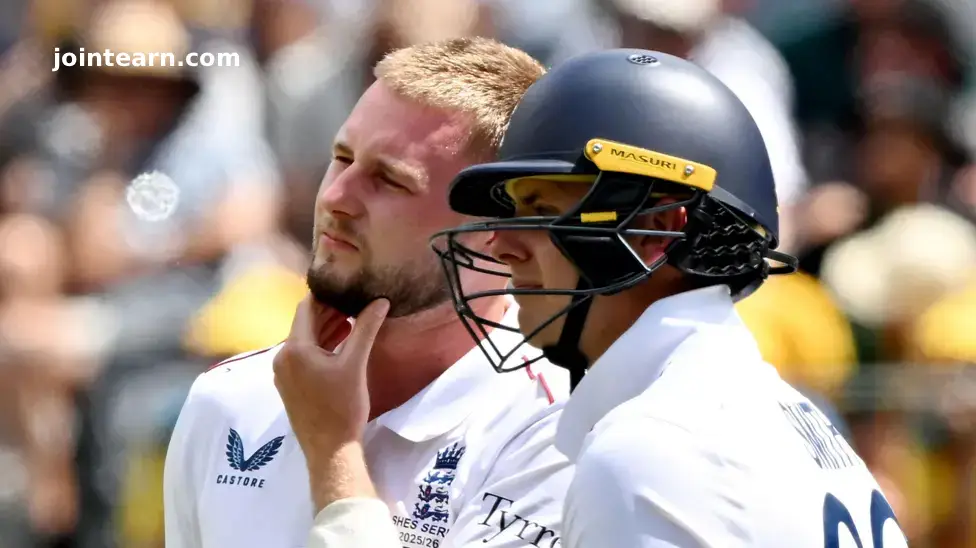
The Ashes never seems to run short of drama, and the 2025–26 series is already living up to its reputation. On day two of the first Test in Perth, England wicketkeeper-batter Jamie Smith was dismissed in a highly debated decision that left fans stunned, players confused, and commentators buzzing.
The moment came during England’s second innings, where a lengthy and complex third-umpire review led to Smith being given out caught behind — despite the on-field decision being not out. The call instantly triggered loud boos from England fans inside Perth Stadium and kicked off heated discussions online and in the cricketing world.
What Sparked the Controversy?
England were under pressure at 104–6 in the 28th over when Mitchell Starc delivered a short ball aimed at Jamie Smith’s leg side. Smith attempted a pull shot, but Australia’s close fielder Travis Head immediately signaled that he heard a faint edge. Wicketkeeper Alex Carey also appealed confidently.
However, on-field umpire Nitin Menon was not convinced and ruled Smith not out. Australian captain Steve Smith reviewed the decision without hesitation.
Within seconds, the third umpire Sharfuddoula began what turned into one of the longest reviews seen in Ashes history.
A Review That Left Everyone Confused
The third umpire’s assessment lasted nearly five minutes — an unusually long time for a caught-behind review.
Commentators on Test Match Special noted how unusual the delay was. When the first RTS (Real Time Snickometer) replay showed a faint noise, Jamie Smith even began walking off the field, thinking he was out. But confusion grew when Sharfuddoula pointed out that the sound spike seemed to appear after the ball passed the bat.
He said:
“As the ball passes the bat, there is nothing there. The ball has already passed the bat.”
Despite this initial conclusion, he continued to re-watch multiple angles and slow-motion clips.
Former England captain Michael Vaughan expressed concern during the broadcast, saying decisions need to be “clear and obvious” and handled within a reasonable timeframe.
Eventually, after reviewing more footage, Sharfuddoula reversed his stance, stating:
“I can see a spike as the ball has just gone past the bat. I am satisfied the ball has made contact.”
He advised the on-field umpire to overturn the original decision — sending Smith back to the pavilion and England deeper into trouble at 104–7.
Did the Third Umpire Make the Correct Call?
The stadium erupted in boos from England supporters, who believed the decision lacked certainty.
But according to ICC regulations for the Decision Review System (DRS):
- If the third umpire cannot determine the correct outcome with a “high degree of confidence,”
- The on-field decision must stand.
In this case, Sharfuddoula evidently felt he had enough evidence to overturn the call.
Former international umpire Simon Taufel, speaking on 7 Cricket, offered insight into how the technology works. He explained that the audio and visual feeds in Australia have a two-frame gap, meaning spikes can appear shortly after the visual point of contact.
Taufel stated:
“If you get a spike up to one frame past the bat, that is conclusive. That’s exactly what happened. For me, the correct decision was made.”
He also mentioned that the production crew tried their best to provide clear footage and help the umpire make an informed ruling.
Interestingly, Vaughan pointed out that Jamie Smith’s own reaction suggested acceptance rather than anger. When he initially saw the replay, Smith began walking off without protest, hinting that he believed there had been some contact.
A Classic Ashes Flashpoint
Ashes series are known for iconic moments, heated debates, and controversial decisions — and this incident will likely be remembered as one of the first major talking points of the 2025–26 campaign.
England were eventually dismissed for 164, setting Australia a target of 205 to win the match. But long after the scoreboard is forgotten, fans and analysts will still be discussing the Jamie Smith decision and how the review unfolded.


Leave a Reply