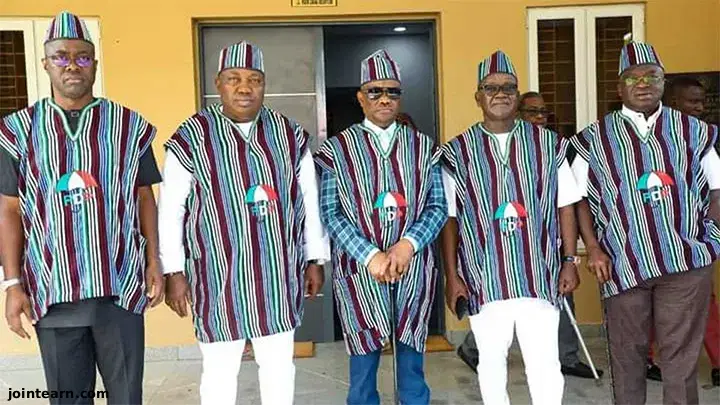
There was a time in Nigerian politics when five governors moved in perfect unison, so much so that even the elders of the PDP seemed to tread lightly. Rivers’ Wike, Oyo’s Makinde, Benue’s Ortom, Enugu’s Ugwuanyi, and Abia’s Ikpeazu were more than just a group—they were a covenant, a political gang whose coordinated appearances earned them the nickname “Aso Ebi Boys.”
Their matching outfits weren’t mere fashion choices; they were political signals. Bold colors, identical embroidery, perfectly angled caps—they all screamed unity and power. It was almost as if their tailor carried a notebook labeled “G5 Strategic Fabrics.” Rumors even suggested they practiced synchronized walks and poses. Nigerians hadn’t seen such coordination since a full NYSC parade.
Within the PDP, the G5’s influence was undeniable. Bold colors warned of brewing tension, whites signaled impending sacrifices, and their collective movements often dictated the party’s responses. Their friendship was louder than any manifesto; they traveled, ate, and plotted together, each with a clear role:
- Wike: The talkative general
- Makinde: The cool-headed strategist
- Ortom: The philosopher-warrior of Benue
- Ugwuanyi: The gentle giant, silent yet steadfast
- Ikpeazu: The calm stabilizer, blending seamlessly into the unity
But as with many political friendships, their sweetness had an expiry date. Election season arrived, and with it, personal ambition. Suddenly, loyalty became optional. Their WhatsApp group, once buzzing with fabric samples and plans, went silent. Messages were read but ignored; emojis vanished.
Wike was the first to explode, openly giving interviews and expressing disappointment. Makinde quietly focused on his second term, ignoring calls for G5 unity. Ortom, humbled by EFCC scrutiny, shifted to survival mode. Ugwuanyi quietly withdrew, and Ikpeazu maintained peace, retreating into political discretion.
By 2023, the once-solid bromance had not only collapsed—it had imploded. Their choices had real consequences:
- Wike and Makinde: Supported Tinubu
- Ortom: Backed Peter Obi
- Ugwuanyi: Stayed neutral, floating between candidates
- Ikpeazu: Maintained distance from party pressures
The G5 didn’t need to campaign against Atiku—they handed his defeat on a silver platter simply through absence and disunity. What had once been a synchronized powerhouse became a fragmented collection of individual ambitions.
Yet, not all was lost. Amid the collapse, Wike and Ortom maintained a personal friendship, surviving the political shipwreck together. The rest scattered, leaving PDP and Nigerians to witness the dramatic end of a power alliance built on ambition, style, and coordination.
The story of the Aso Ebi Boys is a cautionary tale: in politics, friendship built on power is fragile, and once the balance of influence shifts, brotherhood often becomes optional.


Leave a Reply