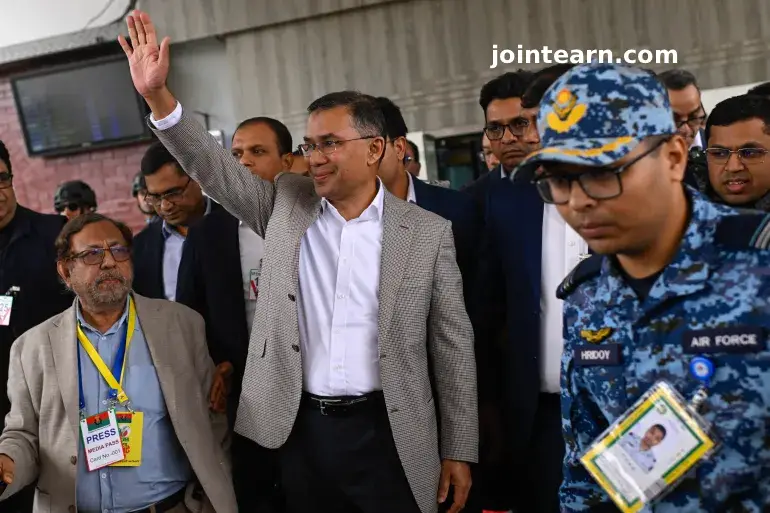
Tarique Rahman, acting chairman of the Bangladesh Nationalist Party (BNP) and a leading prime ministerial candidate, has returned to Bangladesh after nearly 17 years in self-imposed exile in London.
Rahman, 60, fled Bangladesh in 2008 citing politically motivated persecution, and has since been barred from returning due to legal convictions, including money laundering and an alleged assassination plot against former Prime Minister Sheikh Hasina. These convictions were overturned following Hasina’s ouster in 2024, clearing the way for his historic homecoming.
Massive Public Welcome
Upon arrival at Hazrat Shahjalal International Airport in Dhaka, Rahman was greeted by hundreds of thousands of supporters waving party flags, chanting slogans, and carrying banners. He performed a symbolic gesture by removing his shoes and touching Bangladeshi soil, picking up a handful of earth to mark his return.
Addressing the crowd, Rahman pledged unity and inclusion, calling on citizens of all faiths – Muslims, Hindus, Buddhists, and Christians – to join him in creating a secure, democratic, and economically strong Bangladesh.
“We will build a Bangladesh that a mother dreams of… We want peace in the country,” Rahman said, repeating his appeal for harmony three times.
Leadership and Political Impact
As acting chairman of the BNP, Rahman is expected to assume leadership from his critically ill mother, former Prime Minister Khaleda Zia, and lead the party into the February general elections. Analysts view him as the prime ministerial frontrunner, especially as BNP momentum grows following Hasina’s removal from power.
Al Jazeera’s Tanvir Chowdhury notes that Rahman’s return comes during a volatile political period in Bangladesh. “Although the election date has been announced, there’s a vacuum for leadership within the BNP, and his mother has been critically ill,” Chowdhury said. “Tarique Rahman is poised to fill that vacuum and bring unity to a polarised country.”
Shifted Political Landscape
Rahman’s homecoming follows a dramatic political shift in Bangladesh:
- Sheikh Hasina and Khaleda Zia had dominated Bangladeshi politics for decades.
- Khaleda Zia rose to politics after her husband, President Ziaur Rahman, was assassinated in 1981.
- The BNP has regained momentum since Hasina’s ouster in the 2024 student-led uprising.
Recent surveys by the International Republican Institute indicate that the BNP is on course to win the largest number of parliamentary seats in the upcoming election, with Jamaat-e-Islami also in the race. Hasina’s Awami League, barred from the election, has warned of unrest, raising concerns about potential disruptions.
Rahman’s return marks a defining moment for Bangladesh’s political transition under interim government head Muhammad Yunus, as the nation prepares for its first post-Hasina election amid heightened public attention.


Leave a Reply