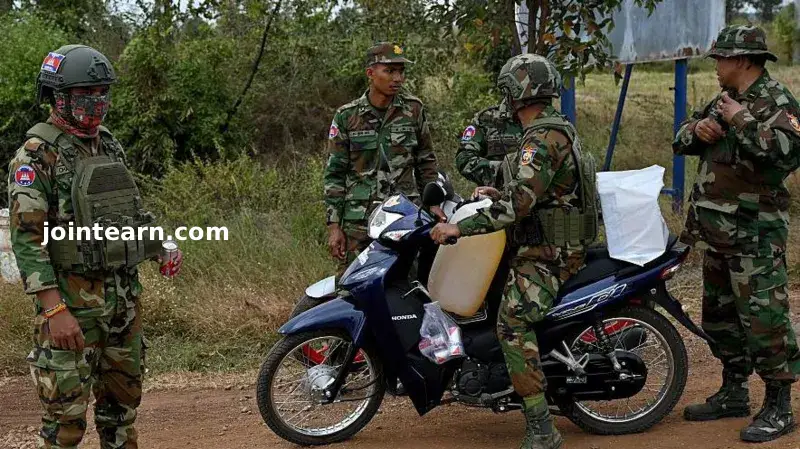
Cambodia has officially closed all its border crossings with Thailand as military clashes continue, despite earlier claims of a ceasefire brokered by US President Donald Trump. The ongoing fighting between Thai and Cambodian forces has led to significant casualties, mass evacuations, and growing concerns over regional stability in Southeast Asia.
Cambodia Closes Borders Amid Renewed Fighting
The Cambodian Interior Ministry announced that all land crossings with Thailand would remain closed until further notice. This decision comes as fighting intensified along multiple points of the border, including Cambodia’s Siem Reap province, a key tourist and cultural area.
Earlier, Thai Prime Minister Anutin Charnvirakul indicated that a ceasefire would only be possible if Cambodia first withdrew its troops and removed landmines from the contested border regions. Thai officials reported four military deaths on Saturday, bringing Thailand’s total military casualties since Monday to 15 soldiers, with 270 others injured. In addition, six civilians were reported injured during the latest skirmishes.
Cambodia has yet to release updated figures on military casualties but confirmed that Thai airstrikes hit hotel buildings and bridges in Cambodian territory. Both nations continue to exchange artillery fire and air strikes, underscoring the fragile and volatile situation at the border.
Humanitarian Impact
The fighting has displaced at least 700,000 people on both sides of the border. Cambodian authorities reported multiple civilian casualties, including 11 deaths and 59 injuries just a day before the border closures. The escalation of violence has prompted fears of a broader humanitarian crisis if hostilities continue without intervention.
US Involvement and Ceasefire Efforts
Earlier this week, former US President Donald Trump claimed that he could halt the fighting simply by contacting the leaders of Thailand and Cambodia. After speaking with both prime ministers on Friday night, Trump announced via social media that both countries had agreed to a ceasefire, stating:
“Both countries are ready for peace.”
However, in subsequent statements, neither Thai nor Cambodian officials confirmed an immediate ceasefire. Thai Prime Minister Anutin emphasized that Thailand was not the aggressor and insisted that Cambodia must first withdraw forces and remove landmines before a true ceasefire could take effect. Cambodian leadership, meanwhile, maintained that continued fighting was necessary to protect national sovereignty.
Unlike the July clashes, there was no mention of using trade tariffs or economic leverage to pressure either side to halt hostilities. Thailand explicitly warned against linking the conflict to trade negotiations with the US.
Recent Military Escalation
The Cambodian Defence Ministry reported that on December 13, 2025, Thai F-16 fighter jets dropped seven bombs on multiple targets in Cambodia, with bombings continuing in subsequent days. The Thai military also confirmed ongoing skirmishes and air strikes inside Cambodian territory.
The border dispute between the two countries has a long historical background, spanning over a century. The 800-kilometer border, drawn by French cartographers in 1907 during Cambodia’s colonial period under France, has been a persistent point of contention. The current wave of fighting reignited after Cambodia launched a rocket barrage into Thailand on July 24, 2025, which prompted Thai airstrikes and several days of intense military engagement.
Despite signing an “immediate and unconditional ceasefire” in October 2025, brokered by Trump and Malaysian Prime Minister Anwar Ibrahim, both sides have accused each other of violations. Thailand has documented Cambodian landmine placements causing injuries to Thai soldiers, while Cambodia claims these mines date back to the 1980s civil war.
Regional Implications
The fighting has affected six provinces in north-eastern Thailand and six provinces in Cambodia’s north and northwest, threatening regional tourism, trade, and cross-border relations. The situation underscores the fragile stability in Southeast Asia, with experts warning that without renewed diplomatic efforts, civilian casualties, displacement, and military escalation could worsen.


Leave a Reply